
Atoll profile
FuvahmulahGnaviyani Atoll.
Single-island atoll at the equator — year-round tiger sharks, freshwater lakes, and the Maldives' only true pelagic dive pilgrimage.
- Islands1
- Inhabited1
- From MLE494 km
- TransferDomestic flight from Maléapprox. 1h 30m
At a glance
The world's most reliable year-round tiger shark diving — one of the largest known resident tiger shark populations on Earth..
Best for
Getting here
Character
Ideal stay
Protected status
For non-divers
Pairs well with
Addu AtollDestination brief
A guide to Gnaviyani Atoll.
Gnaviyani Atoll is the strangest, most isolated place in the Maldives — a single-island atoll consisting entirely of Fuvahmulah, a crescent of land measuring roughly 4.5 km by 1.2 km set alone in the Equatorial Channel between Huvadhu and Addu, 494 km south of Malé and only a fraction of a degree south of the equator. There are no resort islands, no shallow turquoise lagoons, no seaplanes drifting overhead. Instead, Fuvahmulah rises from deep ocean like an island in the Pacific: steep-sided, heavily vegetated, and ringed by currents that draw in pelagic life found almost nowhere else in the archipelago. This is the Maldives of serious divers, not honeymooners.
The interior is unlike any other Maldivian landmass — fertile peat soil, the country's largest mango harvest, fields of taro (ala) cultivated in the traditional wetland style, and the densest Jambul (Syzygium cumini) forest in the Maldives. Two freshwater lakes dominate the island: Bandaara Kilhi in the south (the largest freshwater lake in the country by volume, roughly 14 acres and 15 feet deep) and Dhadimagi Kilhi in the north (6.37 hectares, the second-largest). Both were declared nationally protected wetlands on 12 June 2012, and together with the surrounding marshes they form Fuvahmulah Nature Park — the first wetland park ever opened in the Maldives (2018), developed under an EU- and World Bank-funded climate adaptation programme. The lakes host endemic Maldivian white-breasted waterhen and the common moorhen, which is found nowhere else in the country. Underwater, Fuvahmulah's harbour has been the site of a traditional tuna fishery for generations; when the modern harbour was built in 2004, the daily discarding of fish offcuts trained a resident population of tiger sharks to gather at the cleaning station, and since 2017 the site has been opened to divers.
A 2024 peer-reviewed study in Scientific Reports identified 239 individuals over seven years (84.5% female) at what is now considered the world's largest tiger shark aggregation. Alongside the tigers come thresher sharks at dawn cleaning stations, scalloped hammerheads in the cool months, oceanic mantas in mating aggregations, and — in the right season — whale sharks and silvertips. Fuvahmulah is also culturally distinct: its residents speak Fuvahmulaki baha, a dialect of Dhivehi unintelligible to mainlanders. Stays are in locally owned dive boutique hotels and guesthouses — this is pilgrimage diving, not barefoot luxury.
Fuvahmulah is the only "single-island atoll" in the Maldives — the entire atoll is one circular landmass, formed when the ancient lagoon opening at Diyarehifaando was closed by coral boulders, leaving behind two freshwater lakes (Bandaara Kilhi and Dhadimagi Kilhi), fertile peat soil, and the country's only taro-and-mango farming culture. It is also the only Maldivian atoll whose residents speak a separate Dhivehi dialect — Fuvahmulaki baha — which is not fully intelligible to speakers from Malé.
Field notes
What's here.
Dive sites07
- 01
Tiger Zoo / Tiger Harbour (Shark Point)
the harbour cleaning station, plateau at 6-9 m dropping to 12-15 m, resident tiger shark aggregation daily since 2017
- 02
Thresher Point
pelagic thresher sharks at dawn cleaning stations, typically 12-15 m on calm mornings
- 03
Farikede
hammerhead plateau on the north-east corner, also produces tiger shark counts of up to 21 in a single dive
- 04
Plateau (South Plateau)
deep pelagic wall off the southern tip, 10-30 m+, known for multi-species shark dives (up to seven species in one dive)
- 05
Fuvahmulah Outreef
long submerged reef from the southern tip (10-30 m), the island's most species-diverse pelagic wall
- 06
North East Corner
seasonal window where thresher sharks, oceanic mantas and whale sharks can appear on the same dive
- 07
Rasgethere Miyaruvalhu (Shark Point east)
drift wall feeding into Tiger Harbour, grey reef and silvertip encounters
Marine life07
- 01
Tiger sharks year-round at the harbour cleaning station
the only near-guaranteed encounter in the Maldives, with 239+ individuals documented (Scientific Reports, 2024)
- 02
Pelagic thresher sharks at dawn cleaning stations
12-15 m, best April-November, calm conditions
- 03
Oceanic manta mating aggregations
March-May, plus passing sightings year-round
- 04
Schooling scalloped hammerheads in the cool northeast monsoon
December-March
- 05
Silvertip and grey reef sharks on the outer walls, with occasional silky and oceanic whitetip on the deep plateau
- 06
Whale sharks in transit along the outreef
no fixed season, opportunistic encounters
- 07
Resident dolphins (spinner and bottlenose) in the channel crossings
Notable resorts06
- 01Ocean Pearl Fuvahmulah
4-star modern boutique hotel on the island's western beachfront, rooftop infinity pool, international restaurant
- 02Fuvahmulah Central Hotel
8-room boutique dive resort with all-inclusive shark diving packages, long-running PADI-partnered operation
- 03Tiger Shark Residence & Dive
boutique dive hotel with on-site dive centre, outdoor pool, centrally located
- 04Marina Boutique Hotel
3-star, 8-room property near the harbour, on-site dive service
- 05Hedheykuri Residence Fuvahmulah
newly built guesthouse in Dhoodigan district, 5-8 minutes to airport and harbour
- 06Endhaa, Divers Home
diver-focused guesthouse with spa, shared kitchen and airport transfers, walking distance to Fuvahmulah Airport
When to go
Marine-life calendar.
Best visibility
Year-round
Tiger shark
Year-round · Signature, up-close
Thresher shark
Oct–Dec · Most common
Hammerhead, oceanic manta, mola mola
Seasonal
December to April for hammerheads and best visibility; March to May for oceanic manta mating aggregations; April to November for the highest thresher-shark hit rate. Tiger sharks are year-round. Fuvahmulah sits alone in the open Indian Ocean at the equator, so currents can be strong in any season — this is a pelagic destination, not a calm-lagoon one. Tiger-shark harbour dives run daily regardless of weather, but hammerhead schooling is strongest December-March and thresher sightings peak April-November.
Typical windows — encounters vary year to year; not guaranteed.
Dive sites
Where to dive in Gnaviyani Atoll.
Pelagic wall · expert
Farikede
A signature deep reef with washing-machine currents and apex-predator traffic.
Reef · advanced
North East Corner
An NE corner reef where threshers, oceanic mantas and whale sharks appear in the right conditions.
Pelagic wall · expert
South Plateau
The island's dramatic southern shelf edge — deep blue-water big-animal diving.
Pelagic wall · advanced
Thresher Point
A deep cleaning-station slope for pelagic threshers — a rare shallow-ish thresher encounter.
Pelagic wall · intermediate
Tiger Zoo / Tiger Harbour
One of the few sites on Earth with essentially guaranteed daily tiger-shark encounters.
Curious what you'll meet underwater? Browse the Maldives marine-life guide.
Local islands
Island guides in Gnaviyani Atoll
Inhabited local islands in this atoll with guesthouses, cafés and house reefs — a lower-cost way to stay in Gnaviyani Atoll.
Accommodation Collection
All 26 Properties in Gnaviyani Atoll.

The Sandscape

Isle inn

Scuba Haven Fuvahmulah Dive Guest House

Noya Inn

Ruh Villa

Ataraxis Grand and Spa

Isle Royal Inn

Silver County

Zero Degree Residence, Fuvahmulah

Ocean Pearl Fuvahmulah

Tiger Shark Retreat

Endhaa Divers Home

Extreme Dive Inn Fuvahmulah

Equator Retreat

Hedheykuri Residence

AIG GRAND

Suffix Retreat - Stay, Dive & Explore Fuvahmulah

Maa Thundi

Shark Lounge

FUVAHMULAH INN

Fuvahmulah Central Hotel

Calyx Boutique Fuvahmulah
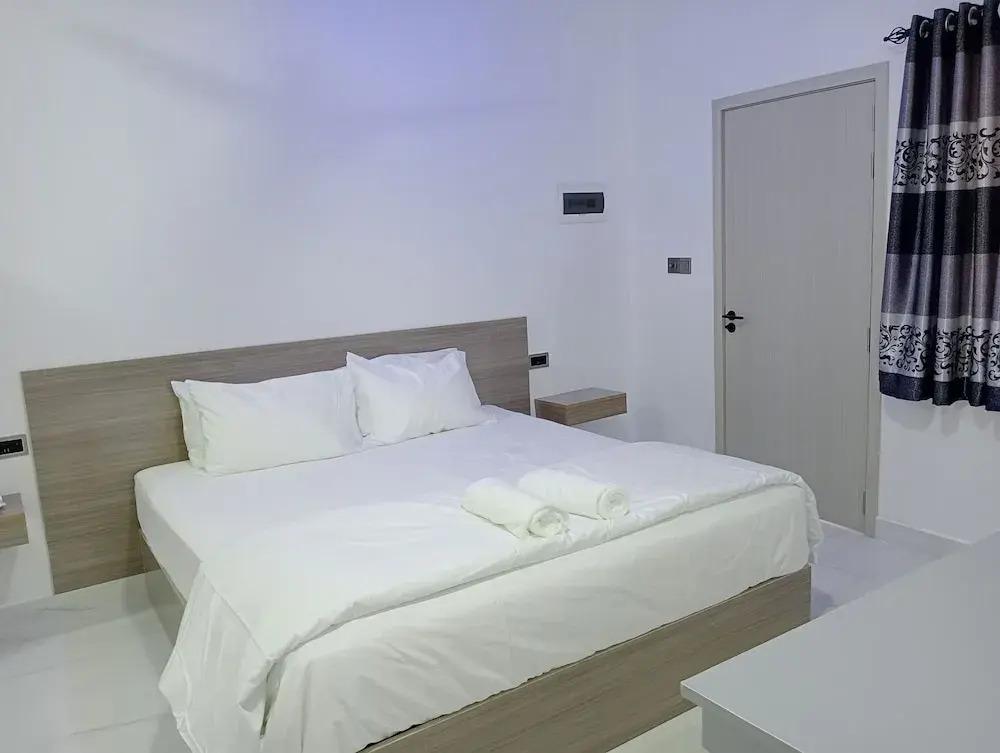
Secret Escape

Vieni Qua Grand
Frequently Asked
Planning a trip to Gnaviyani Atoll.
How do I get to Gnaviyani Atoll?
Gnaviyani Atoll sits approximately 494 km from Velana International Airport (Malé). The standard transfer is Domestic flight from Malé (approx. 1h 30m) to Fuvahmulah Airport (GKK), operational since November 2011. Your resort or guesthouse will typically arrange the transfer as part of your booking.
What is the best time to visit Gnaviyani Atoll?
December to April for hammerheads and best visibility; March to May for oceanic manta mating aggregations; April to November for the highest thresher-shark hit rate. Tiger sharks are year-round.. Fuvahmulah sits alone in the open Indian Ocean at the equator, so currents can be strong in any season — this is a pelagic destination, not a calm-lagoon one. Tiger-shark harbour dives run daily regardless of weather, but hammerhead schooling is strongest December-March and thresher sightings peak April-November.
How many resorts and guesthouses are in Gnaviyani Atoll?
We currently list 26 properties in Gnaviyani Atoll on Resortlife. with options ranging from intimate guesthouses on local islands to ultra-luxury overwater resorts.
Which are the best resorts in Gnaviyani Atoll?
Notable properties include Ocean Pearl Fuvahmulah — 4-star modern boutique hotel on the island's western beachfront, rooftop infinity pool, international restaurant, Fuvahmulah Central Hotel — 8-room boutique dive resort with all-inclusive shark diving packages, long-running PADI-partnered operation, Tiger Shark Residence & Dive — boutique dive hotel with on-site dive centre, outdoor pool, centrally located, Marina Boutique Hotel — 3-star, 8-room property near the harbour, on-site dive service, Hedheykuri Residence Fuvahmulah — newly built guesthouse in Dhoodigan district, 5-8 minutes to airport and harbour. Which resort suits you depends on travel style — honeymoon, family, dive-focused, or budget-conscious — our specialists can match you to the right island.
What is the diving and marine life like in Gnaviyani Atoll?
Key dive sites include Tiger Zoo / Tiger Harbour (Shark Point) — the harbour cleaning station, plateau at 6-9 m dropping to 12-15 m, resident tiger shark aggregation daily since 2017, Thresher Point — pelagic thresher sharks at dawn cleaning stations, typically 12-15 m on calm mornings, Farikede — hammerhead plateau on the north-east corner, also produces tiger shark counts of up to 21 in a single dive, Plateau (South Plateau) — deep pelagic wall off the southern tip, 10-30 m+, known for multi-species shark dives (up to seven species in one dive). Highlights: Tiger sharks year-round at the harbour cleaning station — the only near-guaranteed encounter in the Maldives, with 239+ individuals documented (Scientific Reports, 2024); Pelagic thresher sharks at dawn cleaning stations (12-15 m, best April-November, calm conditions); Oceanic manta mating aggregations (March-May, plus passing sightings year-round). Most resorts operate PADI-certified dive centres with daily boat dives and house-reef snorkelling.
What makes Gnaviyani Atoll unique compared to other Maldives atolls?
Fuvahmulah is the only "single-island atoll" in the Maldives — the entire atoll is one circular landmass, formed when the ancient lagoon opening at Diyarehifaando was closed by coral boulders, leaving behind two freshwater lakes (Bandaara Kilhi and Dhadimagi Kilhi), fertile peat soil, and the country's only taro-and-mango farming culture. It is also the only Maldivian atoll whose residents speak a separate Dhivehi dialect — Fuvahmulaki baha — which is not fully intelligible to speakers from Malé.
Keep exploring
More Maldives atolls.
For travel trade
Quote Gnaviyani Atoll with confidence.
Contracted net rates, multilingual GROs at Velana, charter-flight coordination and 24/7 partner support.