
Atoll profile
ShaviyaniShaviyani Atoll.
A remote northern atoll of pristine reefs and two pioneering luxury resorts, home to the world's first semi-submerged sculpture gallery.
- Islands51
- Inhabited16
- Resort islands2
- From MLE210-270 km
- TransferSeaplane45-55 min
At a glance
One of the most remote, least-developed northern atolls — near-virgin dive sites and standout resorts (Sirru Fen Fushi, JW Marriott Maldives)..
Best for
Getting here
Character
Ideal stay
For non-divers
Destination brief
A guide to Shaviyani Atoll.
Shaviyani Atoll occupies the northern third of the Maldives archipelago, roughly 235-270 kilometres north of Male and corresponding to the northern half of the natural Miladhunmadulu formation. Its remoteness is the point: only a handful of resorts operate across 51 islands, dive sites rarely see more than one group at a time, and the outer reefs still carry the near-untouched staghorn and table-coral cover that has been thinned elsewhere in the country. House reefs here typically drop straight from the waterline into sharp-walled channels where grey reef sharks, silvertips, eagle rays and occasional guitar sharks patrol on incoming tides. The atoll's northerly latitude also means it sits largely above the worst of the southwest-monsoon squalls and enjoys some of the most reliably dry weather in the Maldives between November and April.
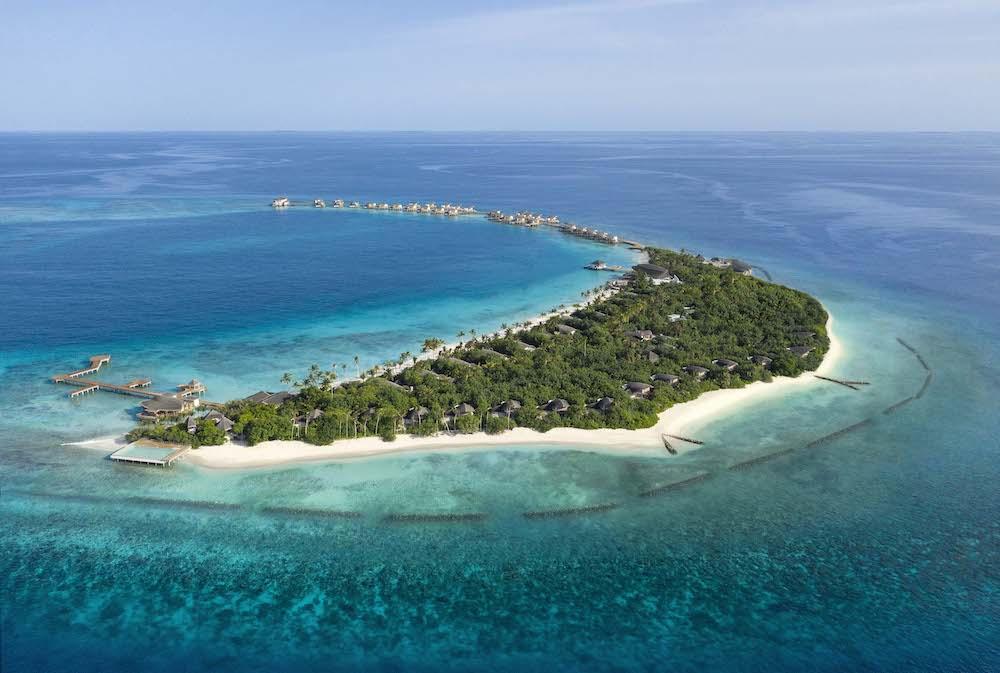
The luxury footprint is still small enough to name in a sentence: Sirru Fen Fushi, distinguished by British artist Jason deCaires Taylor's Coralarium (launched July 2018, the world's first semi-submerged tidal sculpture gallery), and JW Marriott Maldives Resort & Spa on Vagaru Island, reached by a 55-minute seaplane transfer. The capital, Funadhoo, and inhabited islands such as Komandoo and Maaungoodhoo retain a fishing-first economy that has changed little in a generation; the island of Maroshi is historically linked to Bodu Thakurufaanu's 16th-century campaign against Portuguese occupation, when the legendary Kalhuoffummi vessel sheltered in its lagoon at night. Shaviyani suits travellers who value low diver density, intact reef scenery and a frontier-feel stay over central-atoll proximity.
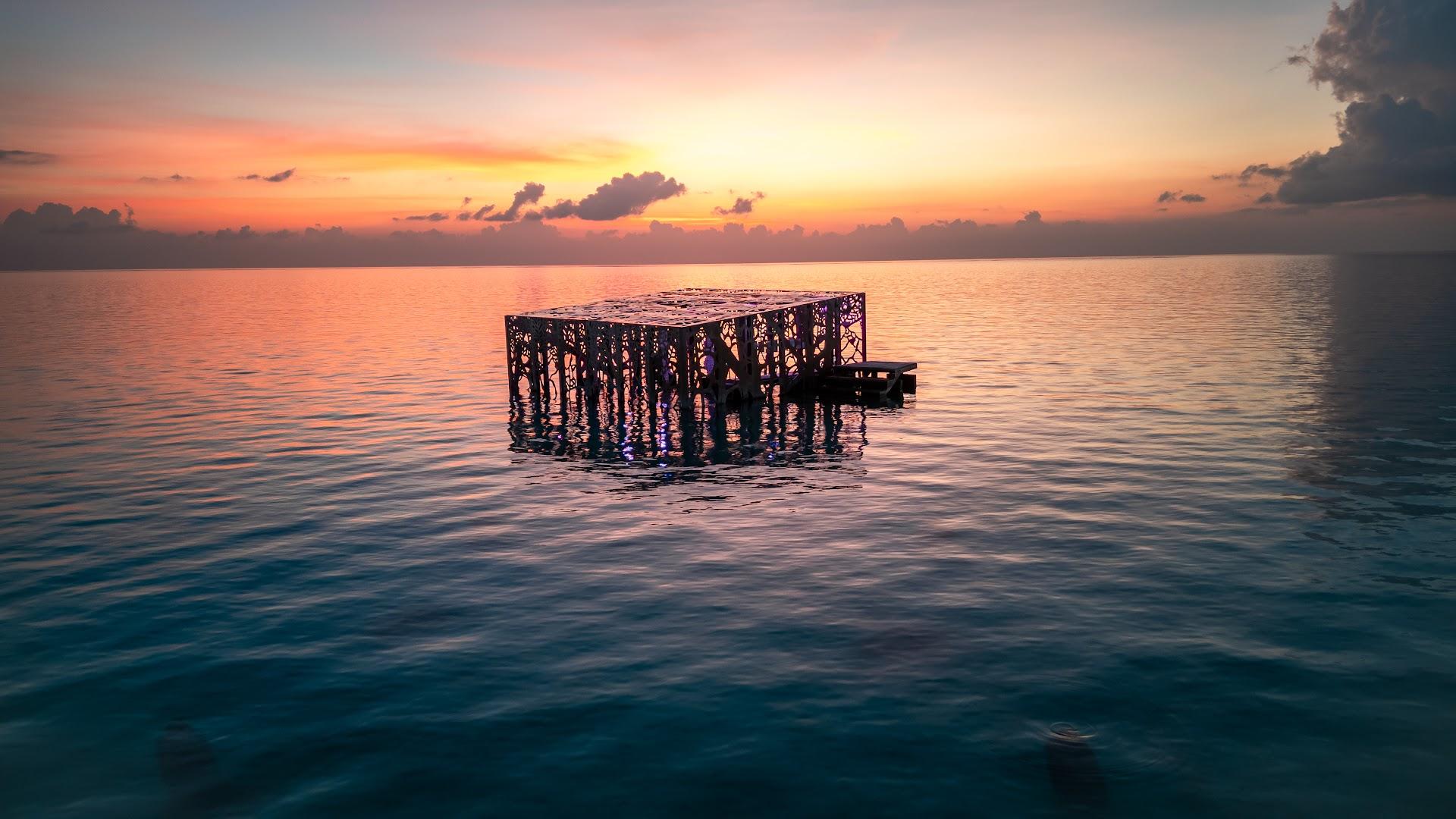
The Coralarium at Sirru Fen Fushi, opened in July 2018, is the world's first semi-submerged tidal art museum. Conceived by British eco-artist Jason deCaires Taylor, the six-metre, 180-tonne stainless-steel cube houses hybrid human-plant-coral sculptures cast from local islanders and is designed to function as a living artificial reef, with pH-neutral marine compounds chosen to attract coral settlement over time.
Field notes
What's here.
Dive sites06
- 01
Loley Thila
- 02
Lupo Thila
- 03
Ekasdhoo North
- 04
Secret Shark Spot
- 05
Kuredhivaru Thila
- 06
Narudhoo Outreef
Marine life05
- 01
Schooling grey reef sharks at Loley Thila
- 02
Silvertip and whitetip sharks on channel dives
- 03
Nurse sharks resting in overhangs at Ekasdhoo North
- 04
Guitar sharks, marble rays and eagle rays on sandy channels
- 05
Intact staghorn and table-coral gardens from 5 metres
Notable resorts02
- 01
- 02
When to go
Marine-life calendar.
Best visibility
Jan–Apr
Sharks (grey, silvertip, nurse)
Year-round · e.g. Secret Shark Spot; species-timing data is thin — verify
Manta & whale shark
May–Nov · Plankton season
November to April (calm seas, driest weather) Shaviyani's northern latitude keeps it among the driest atolls during the northeast monsoon (Nov-Apr). The southwest monsoon (May-Oct) brings squalls and stronger currents but also nutrient-rich water that draws pelagics into the channels.
Typical windows — encounters vary year to year; not guaranteed.
Dive sites
Where to dive in Shaviyani Atoll.
Reef · beginner
Ekasdhoo North
An easy-going coral dive with nurse sharks snoozing under the overhangs.
Thila · advanced
Loley Thila
A south-Shaviyani pinnacle famous for schooling grey reef sharks — liveaboard-accessed.
Thila · advanced
Lupo Thila
A small thila with outsized big-fish and multi-species shark action.
Pelagic wall · advanced
Secret Shark Spot
An off-the-radar pinnacle with reliable reef-shark gatherings.
Curious what you'll meet underwater? Browse the Maldives marine-life guide.
Accommodation Collection
2 Resorts in Shaviyani Atoll.


Frequently Asked
Planning a trip to Shaviyani Atoll.
How do I get to Shaviyani Atoll?
Shaviyani Atoll sits approximately 210-270 km north of Male from Velana International Airport (Malé). The standard transfer is Seaplane (45-55 min) from Velana International. Your resort or guesthouse will typically arrange the transfer as part of your booking.
What is the best time to visit Shaviyani Atoll?
November to April (calm seas, driest weather). Shaviyani's northern latitude keeps it among the driest atolls during the northeast monsoon (Nov-Apr). The southwest monsoon (May-Oct) brings squalls and stronger currents but also nutrient-rich water that draws pelagics into the channels.
How many resorts and guesthouses are in Shaviyani Atoll?
We currently list 5 properties in Shaviyani Atoll on Resortlife. The atoll has roughly 2 resort islands in total, with options ranging from intimate guesthouses on local islands to ultra-luxury overwater resorts.
Which are the best resorts in Shaviyani Atoll?
Notable properties include Sirru Fen Fushi Private Lagoon Resort, JW Marriott Maldives Resort & Spa. Which resort suits you depends on travel style — honeymoon, family, dive-focused, or budget-conscious — our specialists can match you to the right island.
What is the diving and marine life like in Shaviyani Atoll?
Key dive sites include Loley Thila, Lupo Thila, Ekasdhoo North, Secret Shark Spot. Highlights: Schooling grey reef sharks at Loley Thila; Silvertip and whitetip sharks on channel dives; Nurse sharks resting in overhangs at Ekasdhoo North. Most resorts operate PADI-certified dive centres with daily boat dives and house-reef snorkelling.
What makes Shaviyani Atoll unique compared to other Maldives atolls?
The Coralarium at Sirru Fen Fushi, opened in July 2018, is the world's first semi-submerged tidal art museum. Conceived by British eco-artist Jason deCaires Taylor, the six-metre, 180-tonne stainless-steel cube houses hybrid human-plant-coral sculptures cast from local islanders and is designed to function as a living artificial reef, with pH-neutral marine compounds chosen to attract coral settlement over time.
Keep exploring
More Maldives atolls.
For travel trade
Quote Shaviyani Atoll with confidence.
Contracted net rates, multilingual GROs at Velana, charter-flight coordination and 24/7 partner support.