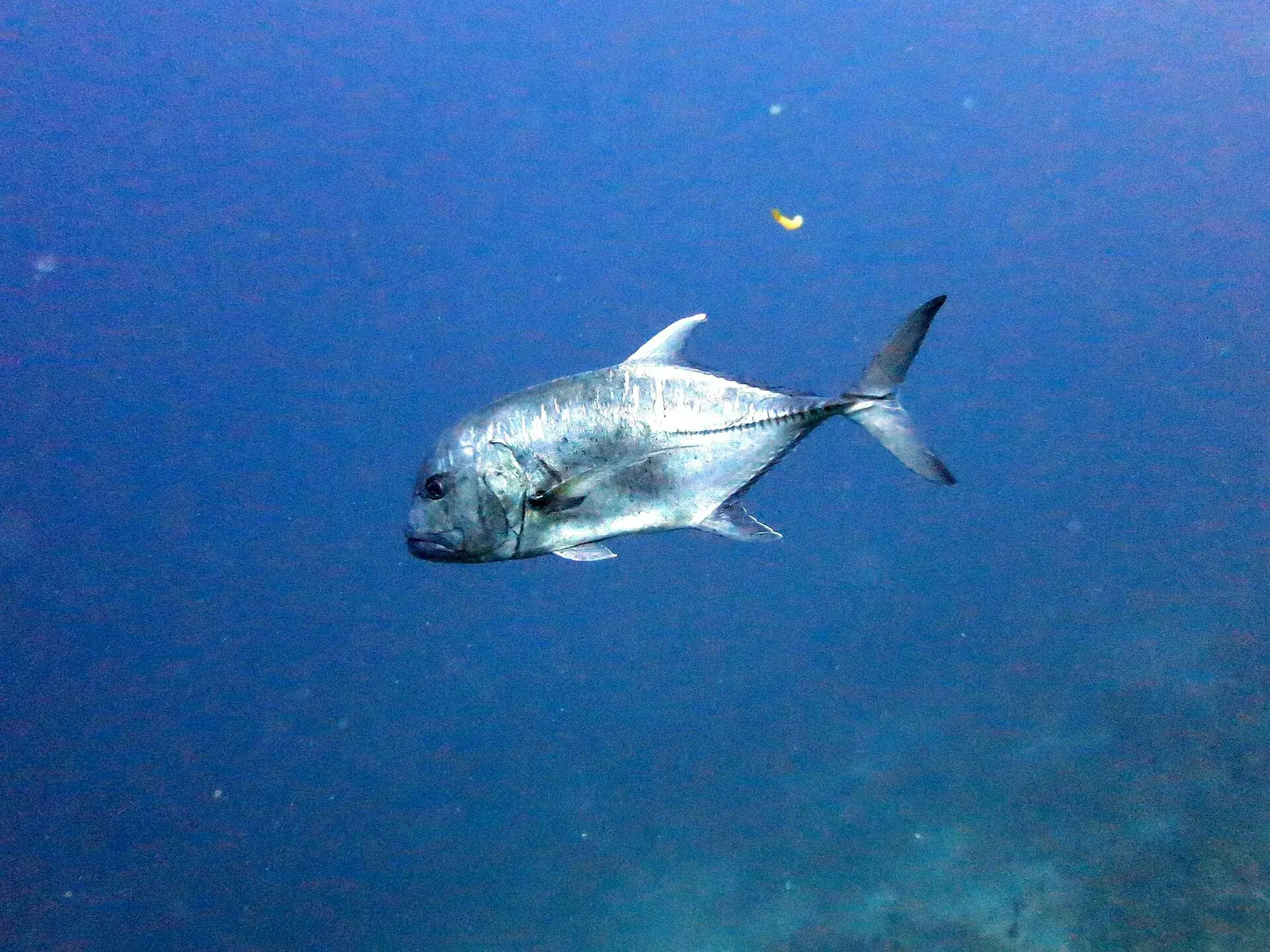
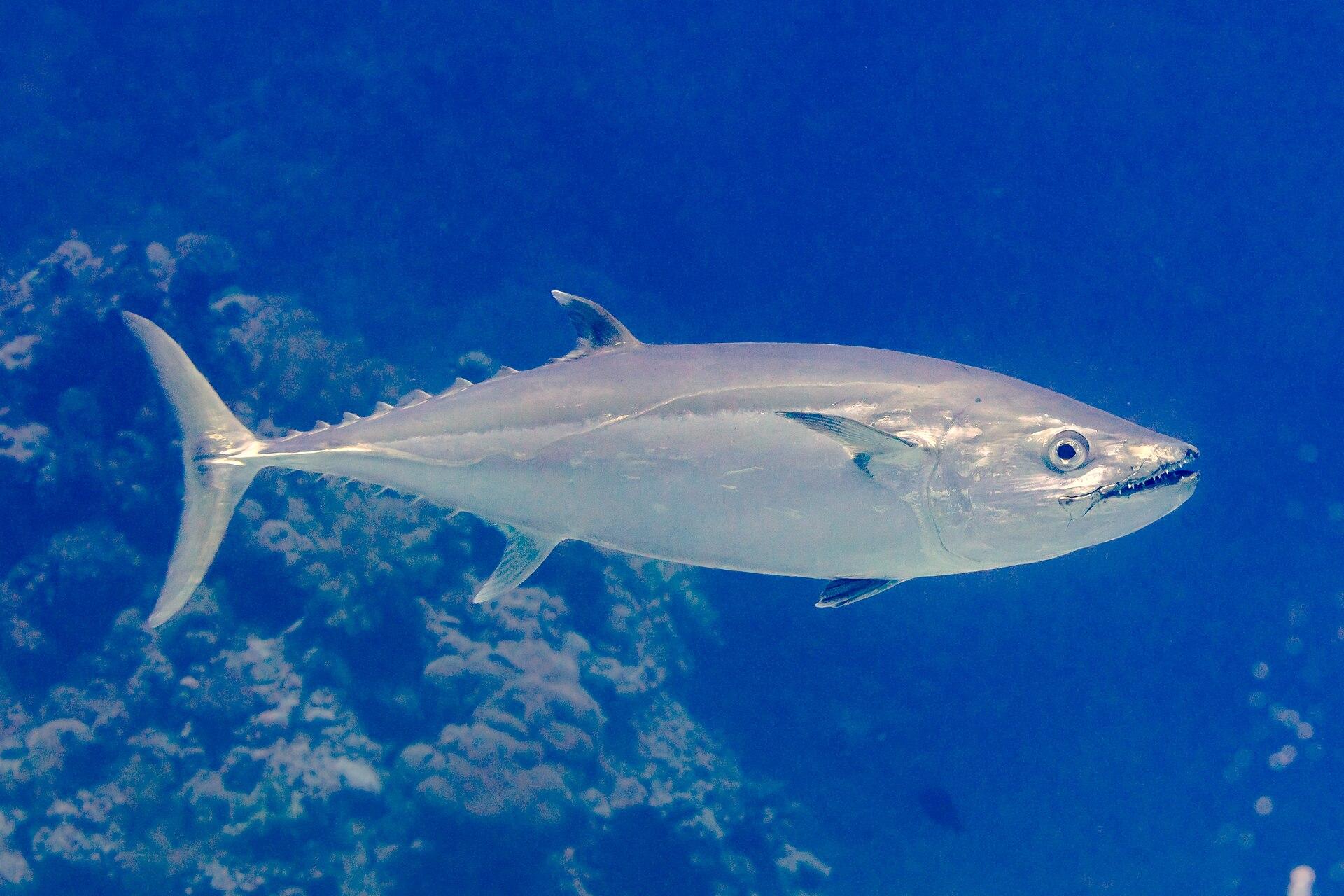
Despite the name it is not a true tuna but a reef-associated bonito — a prized sight on Maldivian channel dives, patrolling the current edge in fast, gleaming squadrons. Named for the conical teeth lining its jaws, it is a powerful hunter that comes in close to reefs and drop-offs.
- Size
- Commonly ~1.1 m; max ~2.5 m
- Weight
- Up to ~130 kg at the largest; most far smaller.
- Diet
- Pelagic schooling fish near reefs, plus cephalopods and crustaceans.
- Lifespan
- At least ~20 years (preliminary).
- Depth
- 0–250 m; commonly ~15–45 m around reefs.
- Reproduction
- Open-water egg scatterer; eggs float and hatch in ~2 days; spawning ~Dec–Feb.
- Snorkel or dive
- Dive
- Best season
- Year-round
- Conservation
- Least Concern
How to recognise it
Streamlined dark-blue/silver body with large conical teeth; mostly scaleless.
Behaviour in the wild
Reef-associated tuna around drop-offs, thilas and seamounts; powerful, fast-cruising predator.
Where to see it in the Maldives
Deeper reef edges and channel walls, e.g. South Malé (Cocoa Thila, Kuda Giri).
Visual field notes
See dogtooth tuna from more than one angle.
3 human-reviewed photographs chosen for identity, habitat and behaviour.
01 · Field portrait · Species reference
PhotoDiego DelsoCC BY-SA 4.0web-adapted
02 · Habitat · Maldives photograph
PhotoTchamiCC BY-SA 2.0web-adapted
03 · Identification · Species reference
PhotoLakshmi SawitriCC BY 2.0web-adapted
Recorded locations
Build a trip from real sighting records.
Atolls
Show 2 more atollsHide extra atolls
Dive and snorkel sites
Explore 4 more recorded sitesHide extra sites
Conservation context
Targeted by game and commercial fishing; large fish carry ciguatera risk.
IUCN · Least Concern
Watch responsibly
Keep calm and let schools approach; avoid sudden movements and don't pursue.
Field notes
One of the few tunas that lives tied to coral reefs rather than the open ocean.
The only member of its genus, endemic to the Indo-Pacific and tied to coral reefs rather than the open ocean.
Collective noun · a school of tuna
Profile references
References are shown transparently; profile copy may also include editorial synthesis. Seasons and sightings vary with wild conditions.