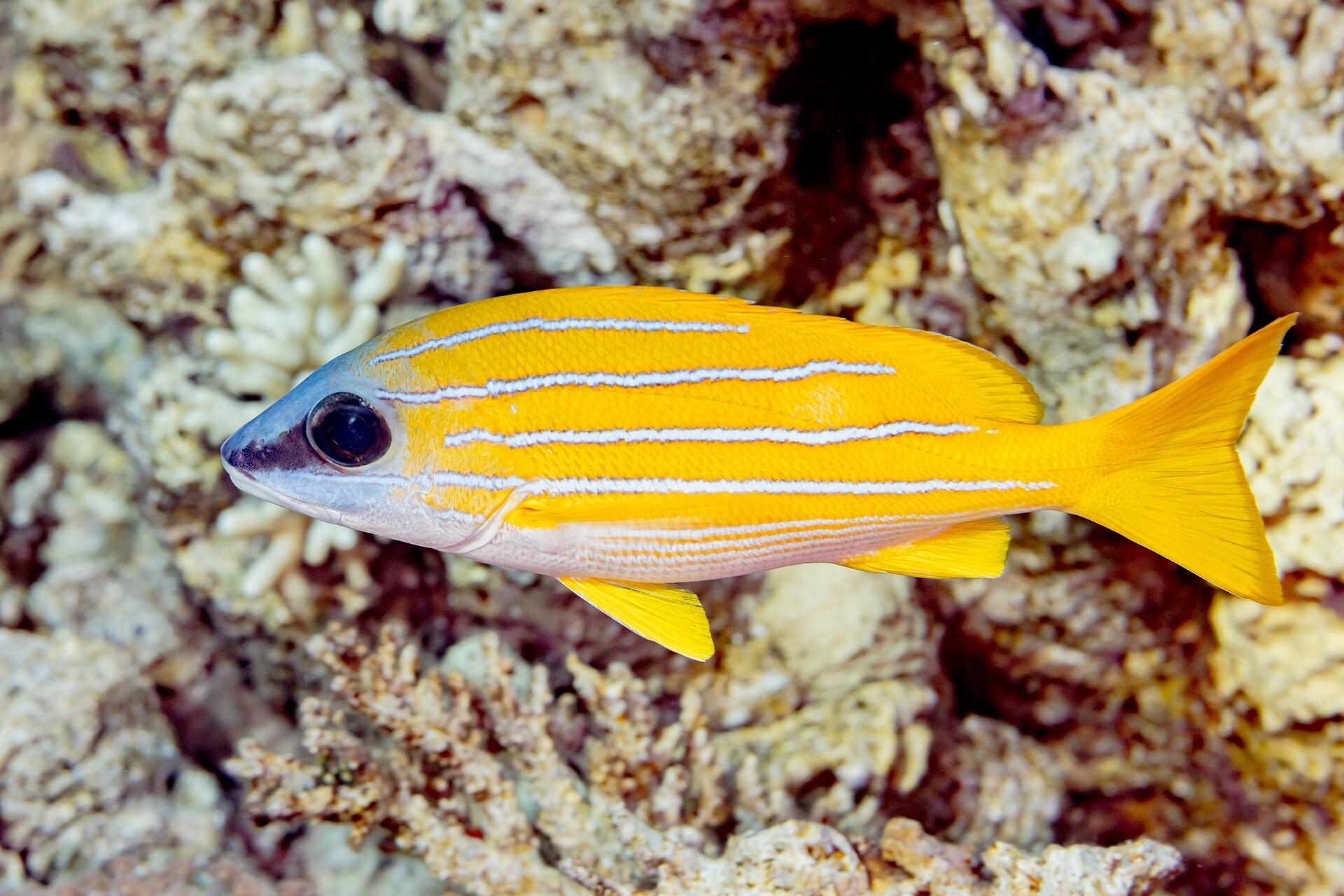
One of the most photogenic reef fish in the Maldives, draping coral heads and wrecks in dense, shimmering golden clouds streaked with electric-blue lines. These tight daytime schools break up at night, when individuals scatter over the sand to hunt. Their reliable aggregations make them a favourite of photographers.
- Size
- ~40 cm
- Diet
- Fish, shrimps, crabs, cephalopods and planktonic crustaceans; some algae.
- Lifespan
- Around 10 years.
- Depth
- 3–265 m; commonly to ~60 m.
- Reproduction
- Matures at 1–2 years; spawns year-round, peaking ~Nov–Dec.
- Snorkel or dive
- Snorkel + dive
- Best season
- Year-round
- Conservation
- Least Concern
How to recognise it
Bright yellow body with four horizontal blue stripes; whitish belly.
Behaviour in the wild
Forms dense photogenic daytime schools around coral heads and overhangs; disperses at night.
Where to see it in the Maldives
Ubiquitous on reefs throughout the atolls — large stationary schools on nearly any house reef or thila.
Visual field notes
See bluestripe snapper from more than one angle.
3 human-reviewed photographs chosen for identity, habitat and behaviour.
01 · Field portrait · Species reference
PhotoDiego DelsoCC BY-SA 4.0web-adapted
02 · Behaviour & scale · Maldives photograph
PhotoUxbonaCC BY-SA 3.0web-adapted
03 · Habitat · Maldives photograph
PhotoJim and Becca WicksCC BY 2.0web-adapted
Recorded locations
Build a trip from real sighting records.
Atolls
Show 3 more atollsHide extra atolls
Dive and snorkel sites
Explore 2 more recorded sitesHide extra sites
Conservation context
Locally fished but abundant and not threatened.
IUCN · Least Concern
Watch responsibly
Approach schools slowly from the side so they stay tight rather than scattering; no touching.
Field notes
Introduced to Hawaii in the 1950s, where it became the most abundant introduced reef fish.
Introduced to Hawaiian waters in the 1950s, where it became an invasive species.
Collective noun · a school of snapper
Profile references
References are shown transparently; profile copy may also include editorial synthesis. Seasons and sightings vary with wild conditions.