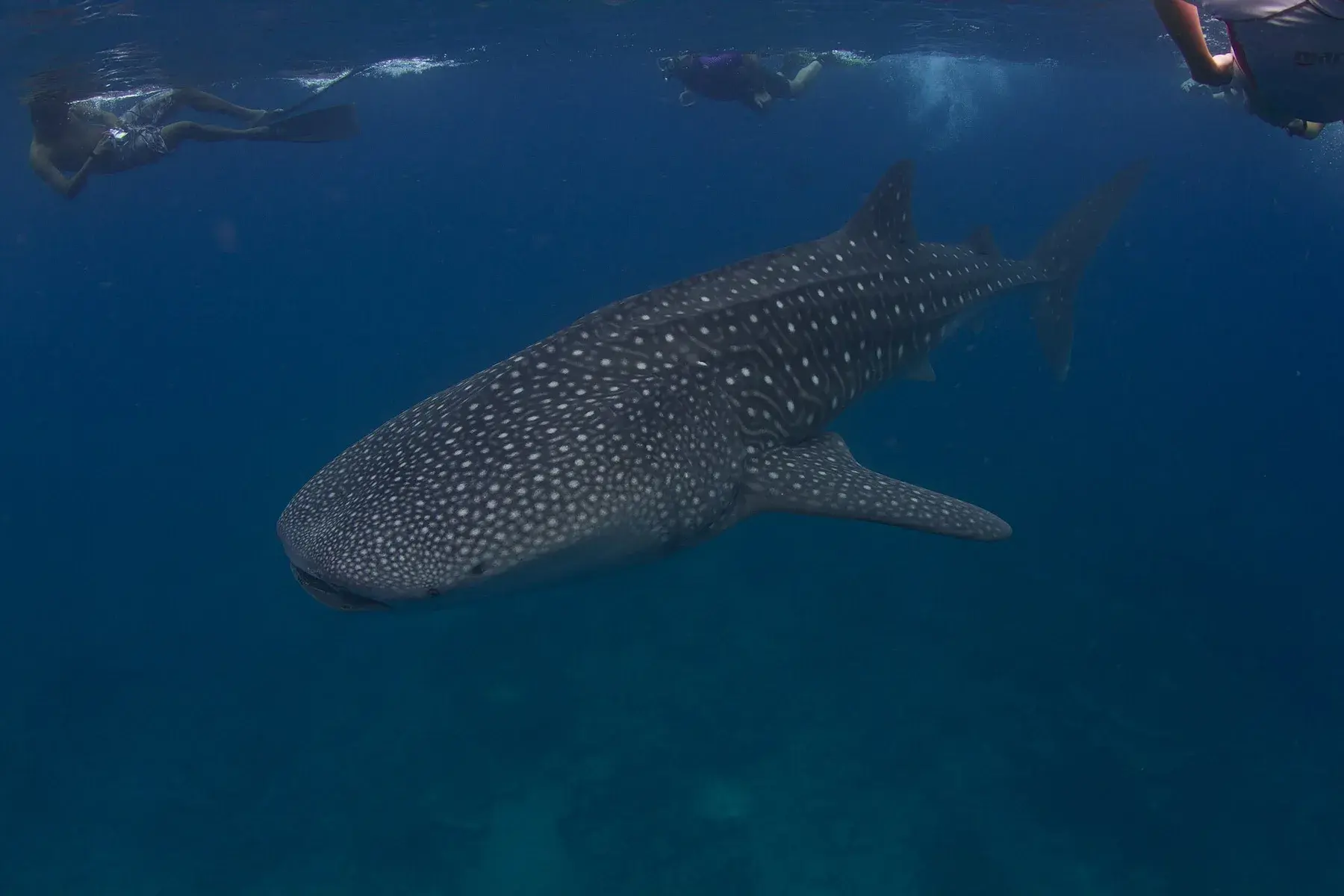
The largest fish alive — a filter-feeding giant that can reach 12–18 m yet eats some of the ocean's smallest prey. Its pattern of pale spots is as unique as a fingerprint, and South Ari Atoll hosts one of the world's few year-round aggregations. Despite its size it is utterly harmless to swimmers.
- Size
- Commonly 8–12 m; up to ~18 m — the largest fish
- Weight
- Commonly up to ~20 tonnes.
- Diet
- Plankton — copepods, krill, fish eggs — plus small fish and squid.
- Lifespan
- Roughly 80–130 years (estimates vary).
- Depth
- Usually surface to ~100 m; recorded diving to ~1,900 m.
- Reproduction
- Ovoviviparous; one female carried 300+ embryos. Matures very late (~30 yrs).
- Snorkel or dive
- Snorkel
- Best season
- Year-round in South Ari
- Conservation
- Endangered
How to recognise it
Enormous; flattened head; checkerboard of pale spots and stripes on a grey-blue back.
Behaviour in the wild
Slow-moving plankton filter feeder; harmless; often cruises near the surface.
Where to see it in the Maldives
South Ari Atoll (SAMPA) around Maamigili and Dhigurah — a resident, year-round population.
Visual field notes
See whale shark from more than one angle.
3 human-reviewed photographs chosen for identity, habitat and behaviour.
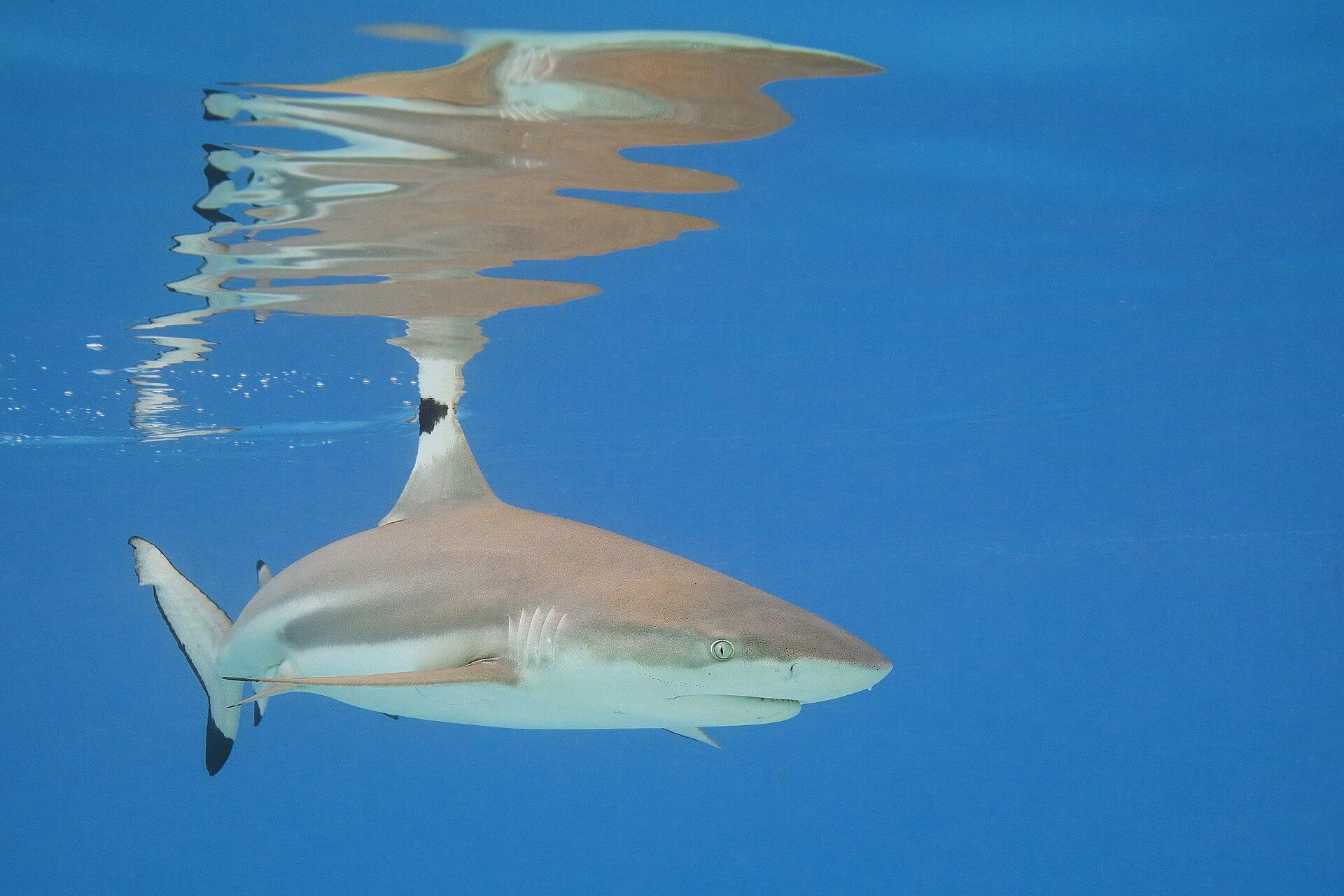
01 · Field portrait · Maldives photograph
PhotoTchamiCC BY-SA 2.0web-adapted
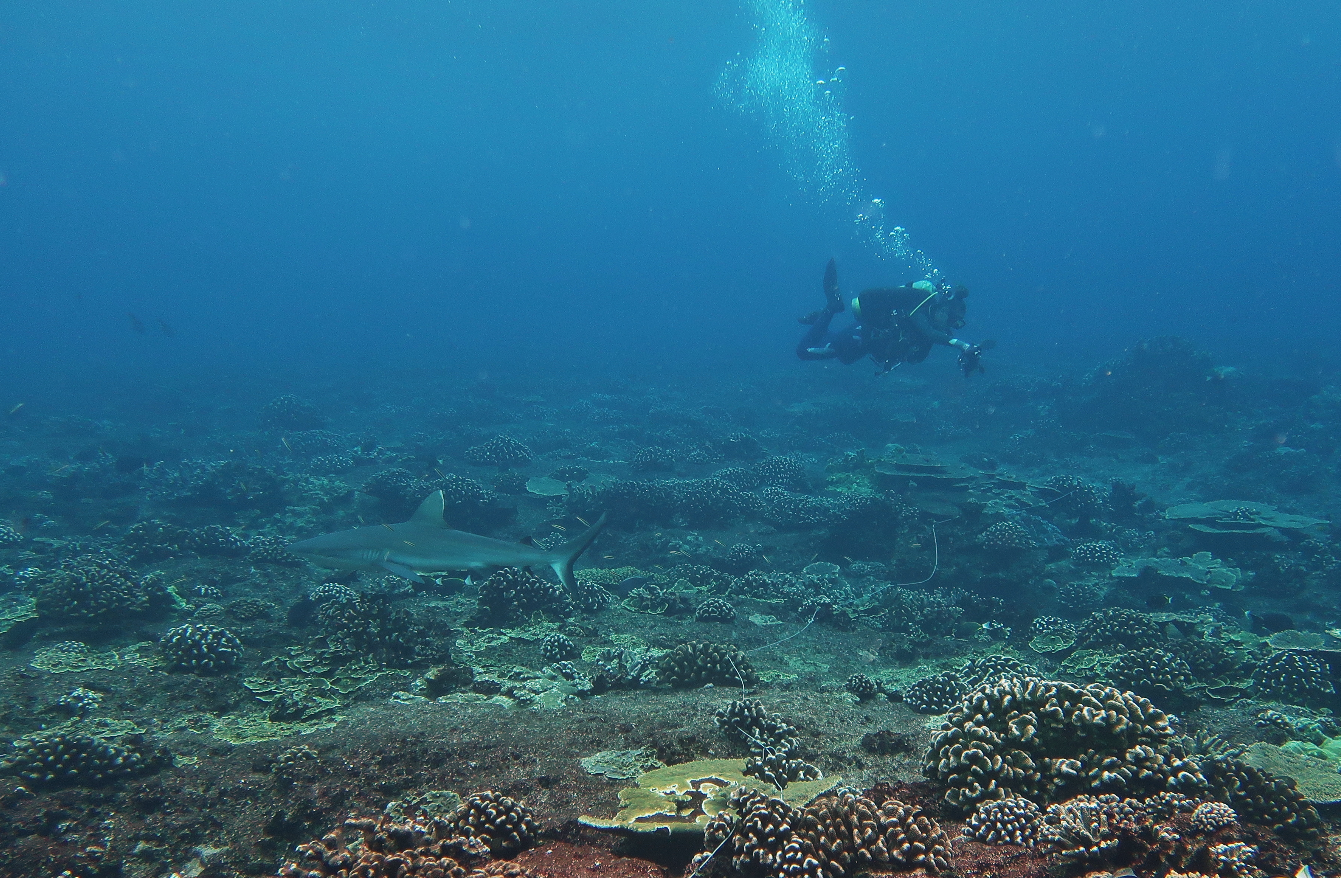
02 · Behaviour & scale · Maldives photograph
PhotoJerome Paillet (IFREMER, Laboratoire d'Océanographie Physique et Spatiale, Centre Bretagne - ZI de la Pointe du Diable - CS 10070 - 29280 Plouzané)CC BY 4.0web-adapted
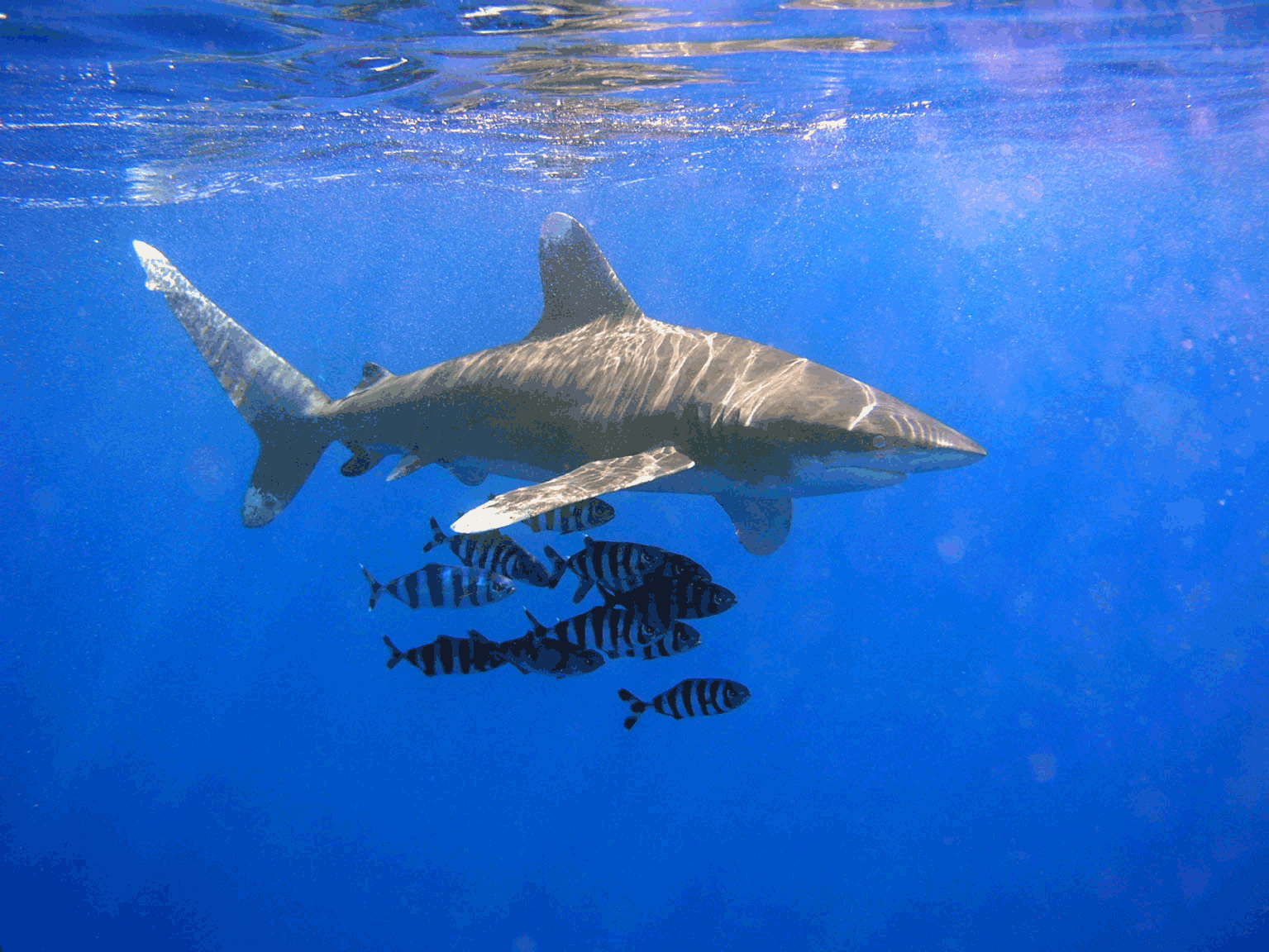
03 · Identification · Maldives photograph
PhotoFotografía propia tomada en MaldivasCC BY 4.0web-adapted
Recorded locations
Build a trip from real sighting records.
Atolls
Show 1 more atollsHide extra atolls
Dive and snorkel sites
Explore 3 more recorded sitesHide extra sites
Conservation context
Fisheries and finning, bycatch, vessel strikes; late maturity slows recovery.
IUCN · Endangered
Watch responsibly
Follow the Maldives guideline: stay at least 3 m from the head and body and 4 m from the tail. Never touch, block its path, use flash, or free-dive beneath it.
Field notes
Each whale shark's spot pattern is unique and ID'd using NASA star-mapping algorithms.
Pups develop at staggered stages inside the mother (asynchronous gestation) — one litter can hold embryos of many ages.
Collective noun · a shiver of sharks
Profile references
References are shown transparently; profile copy may also include editorial synthesis. Seasons and sightings vary with wild conditions.