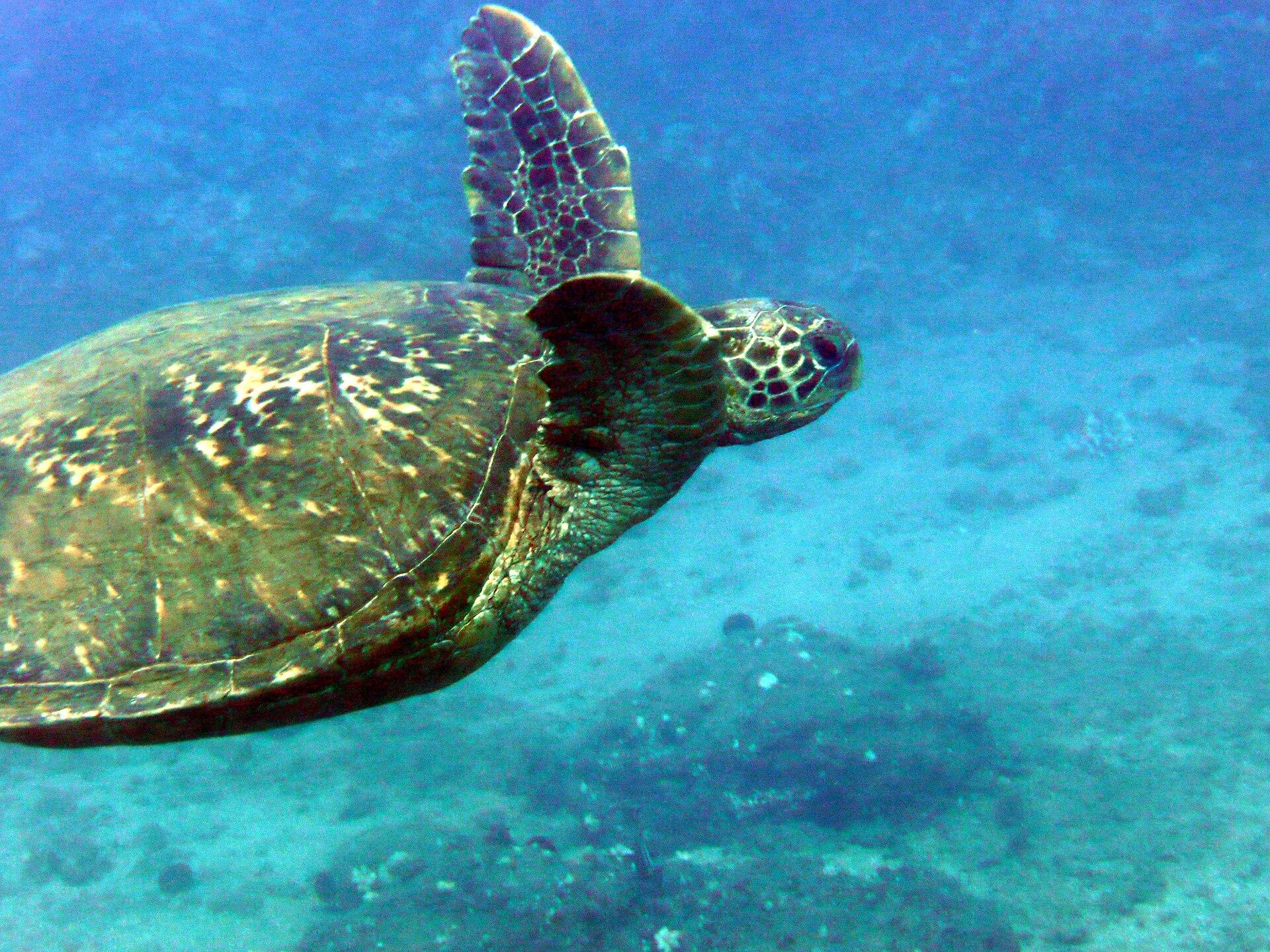
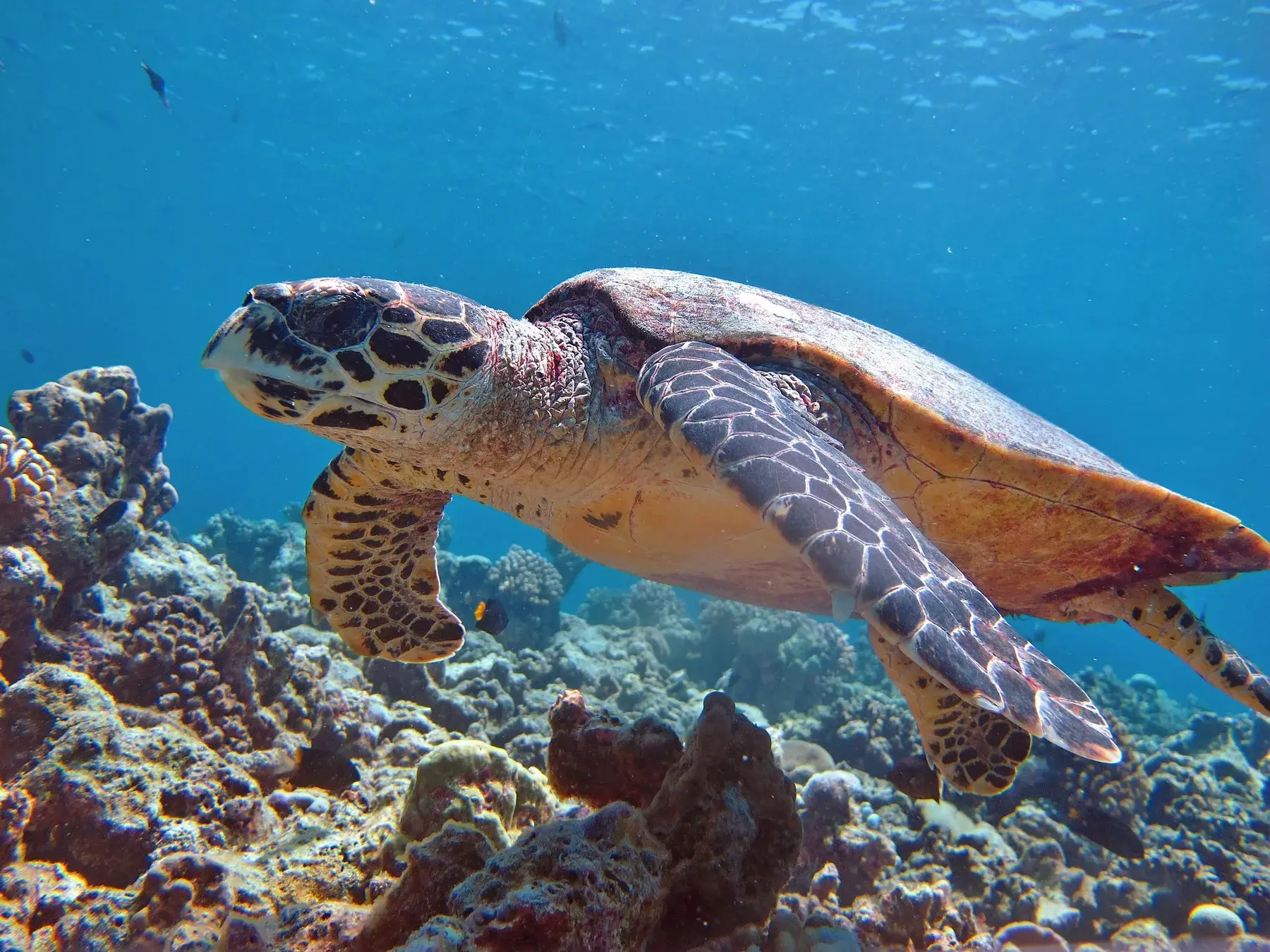
Named for its narrow, raptor-like beak, the hawksbill is the reef's sponge specialist, threading into crevices bulkier turtles can't reach. Its amber-and-brown "tortoiseshell" shell is also its curse — centuries of trade drove it to the brink. It is one of few reptiles that eats toxic sponges, storing the toxins so its own flesh becomes poisonous.
- Size
- ~90 cm carapace, up to ~80 kg
- Weight
- Typically ~45–70 kg; large individuals over 80 kg.
- Diet
- Mainly sponges, plus anemones, jellyfish, molluscs and algae.
- Lifespan
- Matures at 20–40 years; estimated 50–100+ years.
- Depth
- Typically foraging 8–20 m; dives to ~90 m.
- Reproduction
- Nests every 2–3 years, 3–6 clutches of ~130–140 eggs; ~60-day, temperature-dependent incubation.
- Snorkel or dive
- Snorkel + dive
- Best season
- Year-round; nesting peaks Jun–Sep
- Conservation
- Critically Endangered
How to recognise it
Narrow pointed hawk-like beak; overlapping scutes giving a serrated rear shell edge.
Behaviour in the wild
Reef-associated; forages on sponges among coral; curious and tolerant of snorkellers.
Where to see it in the Maldives
The turtle most reliably seen on resort house reefs across all atolls (N/S Malé, Ari, Baa).
Visual field notes
See hawksbill turtle from more than one angle.
3 human-reviewed photographs chosen for identity, habitat and behaviour.
01 · Field portrait · Maldives photograph
PhotoMDC SeaMarc MaldivesCC BY-SA 4.0web-adapted
02 · Identification · Species reference
PhotoDiego DelsoCC BY-SA 4.0web-adapted
03 · Habitat · Maldives photograph
PhotoJan Ebr & Ivana EbrováCC BY 4.0web-adapted
Recorded locations
Build a trip from real sighting records.
Atolls
Show 7 more atollsHide extra atolls
Dive and snorkel sites
Explore 12 more recorded sitesHide extra sites
Conservation context
Tortoiseshell trade, egg/meat harvest, reef and beach loss, plastic, entanglement.
IUCN · Critically Endangered
Watch responsibly
Keep a low, calm profile and never block its path to the surface to breathe; observe, don't touch.
Field notes
Their sponge-heavy diet can make their flesh toxic to humans.
Critically Endangered — roughly 8,000 nesting females are thought to remain worldwide.
Collective noun · a bale of turtles
Profile references
References are shown transparently; profile copy may also include editorial synthesis. Seasons and sightings vary with wild conditions.