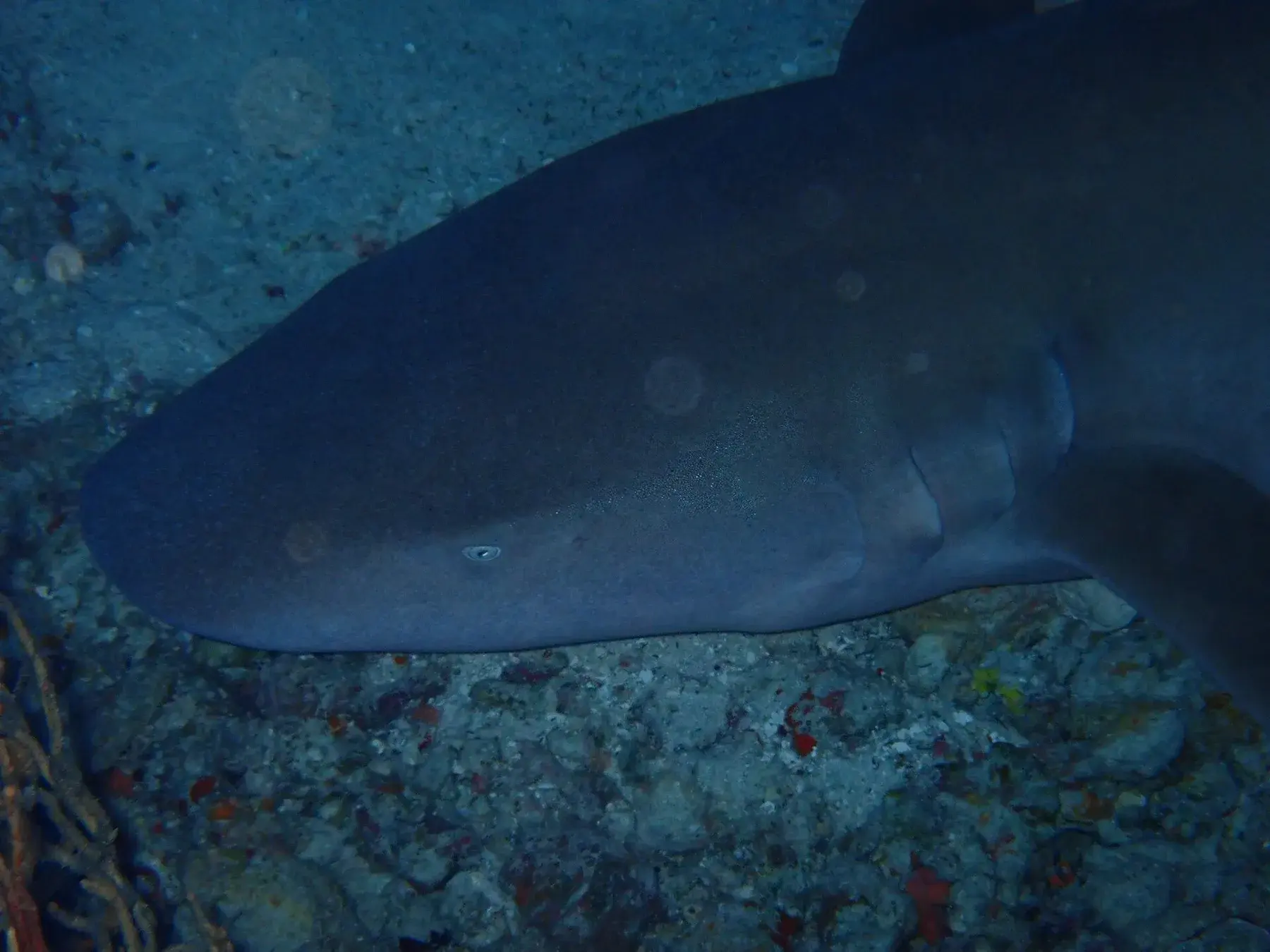
A heavy-bodied, sluggish bottom-dweller with tiny eyes and trailing barbels, often found dozing in caves by day, sometimes piled in groups. It is a powerful suction-feeder, able to vacuum prey out of crevices with an audible slurp. Slow and docile, but its small mouth generates remarkable suction force.
- Size
- ~3.0–3.2 m
- Diet
- Octopus, crustaceans, sea urchins, corals and reef fishes — sucked from holes.
- Lifespan
- Not firmly established; likely a few decades.
- Depth
- Shallows to ~70 m; usually 5–30 m.
- Reproduction
- Ovoviviparous with oophagy (embryos eat unfertilised eggs in utero); small litters.
- Snorkel or dive
- Dive
- Best season
- Year-round
- Conservation
- Vulnerable
How to recognise it
Broad flattened head with two barbels by the mouth; small mouth; rusty-brown; sluggish.
Behaviour in the wild
Nocturnal bottom-feeder; rests by day piled in caves; suction-feeds on crustaceans and octopus.
Where to see it in the Maldives
Atoll-wide in caves; the signature draw of the Alimatha night dive (Vaavu).
Visual field notes
See tawny nurse shark from more than one angle.
3 human-reviewed photographs chosen for identity, habitat and behaviour.
01 · Field portrait · Maldives photograph
PhotoJean-Paul BoerekampsCC0web-adapted
02 · Behaviour & scale · Maldives photograph
PhotoJean-Paul BoerekampsCC0web-adapted
03 · Habitat · Maldives photograph
PhotoJean-Paul BoerekampsCC0web-adapted
Recorded locations
Build a trip from real sighting records.
Atolls
Show 2 more atollsHide extra atolls
Conservation context
Fisheries for meat, fins and liver oil; reef habitat loss.
IUCN · Vulnerable
Watch responsibly
Never grab or ride a resting nurse shark; keep clear of the caves where they rest.
Field notes
Generates strong suction to vacuum prey out of crevices — you can sometimes hear the slurp.
Its suction feeding is strong enough to be heard underwater — it can spit and re-suck prey to reposition it.
Collective noun · a shiver of sharks
Profile references
References are shown transparently; profile copy may also include editorial synthesis. Seasons and sightings vary with wild conditions.