
The Night the Maldives Became Muslim.
How a single night of recitation — and a far longer, harder campaign — set the spine of Maldivian identity for eight hundred years.
King Dhovemi converts to Islam under the influence of a traveling Sunni scholar — tradition names him Abu al-Barakat Yusuf al-Barbari. He becomes Sultan Muhammad al-Adil, and his dynasty rules for the next 800 years. Islam becomes — and remains — the soul of Maldivian identity.
The night of the demon.
By tradition, the people of Malé were terrorised by a sea-demon named Rannamaari, who demanded a young girl be sacrificed at every full moon. A wandering Muslim traveller — Abu al-Barakat Yusuf al-Barbari — took the next girl's place and spent the night inside the temple reciting the Qur'an.
By morning the demon had fled into the sea and never returned. King Dhovemi Kalaminja converted on the spot, took the name Sultan Muhammad al-Adil, and ordered his people to follow. A dynasty had begun that would rule for eight hundred years.
Who was Abu al-Barakat?.
Ibn Battuta, visiting two centuries later, called him a Moroccan. A strong competing tradition names him a Persian from Tabriz — Yusuf Shams al-Din al-Tabrizi — and other sources a Somali Berberi from the Horn of Africa. The truth is lost — but his tomb in the Medhu Ziyaaraiy shrine, opposite the Hukuru Miskiy in Malé, is still a place of quiet pilgrimage.
Faith, slower and harder.
The real conversion was almost certainly slower, more contested and more political than the legend admits. The 12th-century Loamaafaanu copperplates — issued barely forty years later — record stupas ordered destroyed, monks who refused to convert beheaded, and Shariah enforced by a corps of religious police.
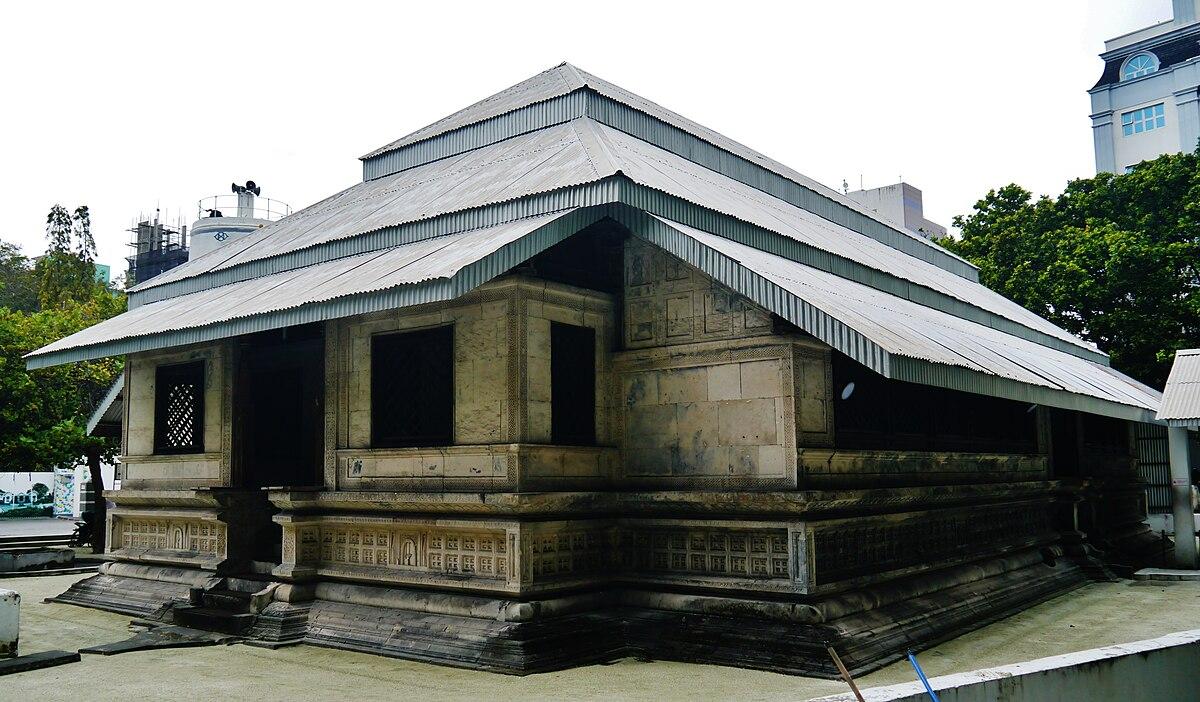
A thousand years of Buddhist institutional life did not end in a single night. But the cultural fact is undeniable: from 1153 onward, Islam is the spine of Maldivian identity — and the coral-carved Hukuru Miskiy of the 1650s still stands as its monument.
The king, seeing that Abu al-Barakat had defeated the sea-demon through the word of God, converted on the spot, and his people followed him.
The long arc.
- 1153
The conversion
King Dhovemi adopts Islam and becomes Sultan Muhammad al-Adil; an 800-year line of sultans begins.
- 1194
Law in copper
The Loamaafaanu copperplates codify Islamic rule — and the suppression of what came before.
- 1656–58
Built in coral
Hukuru Miskiy, the Old Friday Mosque, rises on an older mosque's ruins under Sultan Ibrahim Iskandhar I, carved entirely from coral stone.
- Today
The constant
Islam remains the official faith and the core of Maldivian identity.
Continue the timeline.
- Ibn Battuta, Riḥla (c. 1355)
- Bell, H. C. P. The Maldive Islands: Monograph on the History, Archaeology and Epigraphy (1940)
Two thousand years of history — one extraordinary place to experience it.
The atolls in this story are the islands you can stay on today: private-island resorts and overwater villas, planned by a team that works from inside the Maldives.