
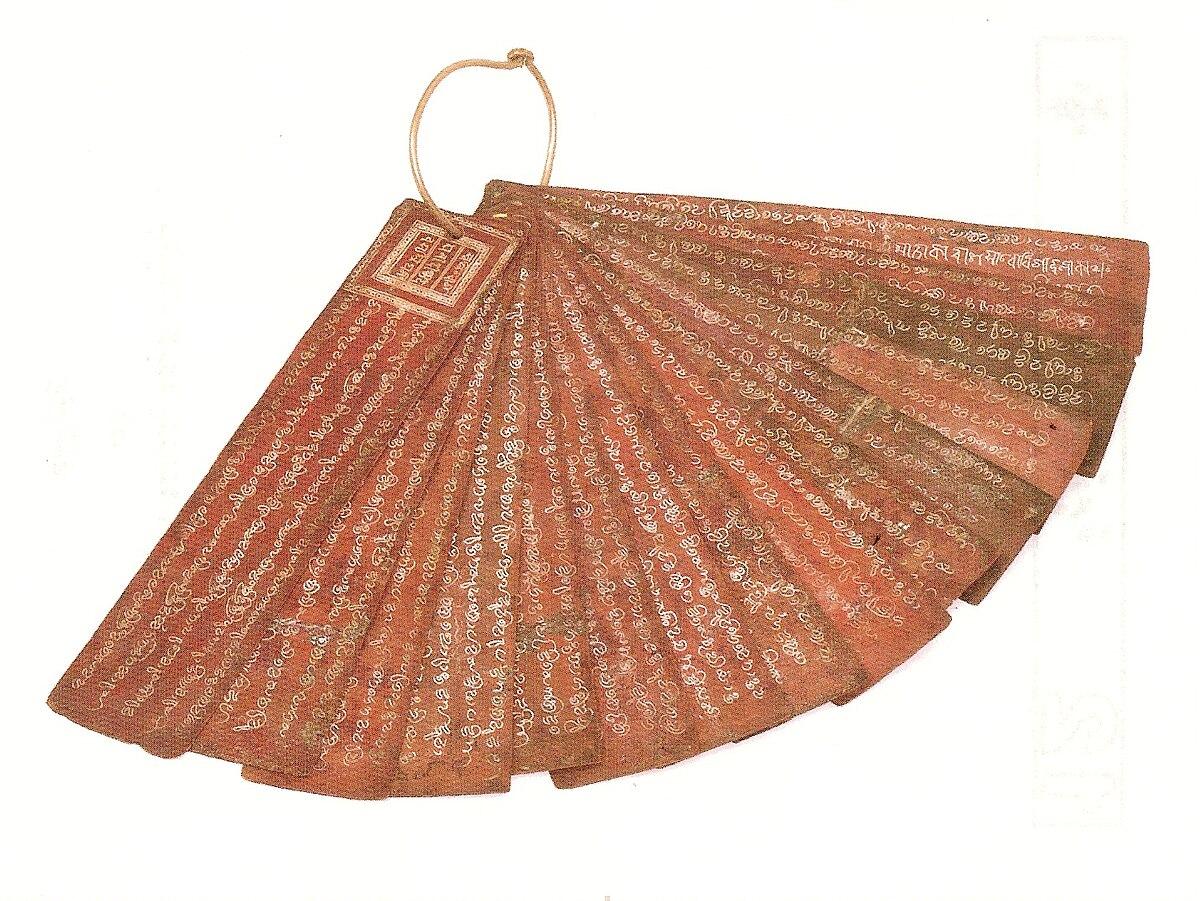
The Copperplate Decrees.
King Sri Gadana Aditya inscribes royal Islamic law onto copperplates — the Loamaafaanu. The rolls from Isdhoo and Dhanbidhoo record the systematic, often violent erasure of the Buddhist world that came before, ordering the destruction of stupas, the beheading of monks, and the installation of a new religious police.
Forty years after the official conversion to Islam, King Sri Gadana Aditya of the Theemuge (Lunar) dynasty issued a series of royal grants inscribed on copperplates — known in Dhivehi as Loamaafaanu. The oldest surviving sets are from Isdhoo (1194) and Dhanbidhoo (1196).
The plates are both administrative documents and religious charters. They order the construction and upkeep of mosques, prescribe the observance of Ramadan in meticulous detail, and instruct villagers to 'lay the trenches, place grass and flowers, sound the five-fold ceremonial drum' at each major feast. The mosques are to be kept 'as a garden'.
They also document something the folk tradition of the peaceful conversion leaves out. The Isdhoo and Dhanbidhoo plates describe the violent suppression of Buddhism in the southern stronghold of Haddhunmathi: stupas ordered disfigured and destroyed, Buddhist monks who refused to convert captured, brought to Malé, and beheaded. Enforcement was overseen by royal officers called hangubeykalun and religious judges called pediyaaru.
The Loamaafaanu are, among other things, the single most important historical source for how a medieval Indian Ocean kingdom actually transitioned from one religion to another. They do not describe a miracle. They describe a policy.
Continue the timeline.
- Hassan Didi, Muhammad. Isdhoo Loamaafaanu (transcription and translation)
- Bell, H. C. P. Epigraphia Zeylanica (Vol. III)
Two thousand years of history — one extraordinary place to experience it.
The atolls in this story are the islands you can stay on today: private-island resorts and overwater villas, planned by a team that works from inside the Maldives.