
Fourteen Centuries of Buddhism.
Theravada Buddhism flourishes across the atolls for more than 1,400 years. Coral-carved stupas, monasteries and Sanskrit-inscribed artefacts rise on dozens of islands — a quiet, connected kingdom stitched into the monsoon trade routes between India, Sri Lanka and South-East Asia.
For at least fourteen centuries — and possibly much longer — the Maldives were a Theravada Buddhist kingdom, culturally and linguistically tethered to Sri Lanka and the Kalinga kingdom on India's eastern coast. Monks travelled as far as the great universities of Nalanda and Vikramashila, returning with Sanskrit texts and Devanagari scripts.
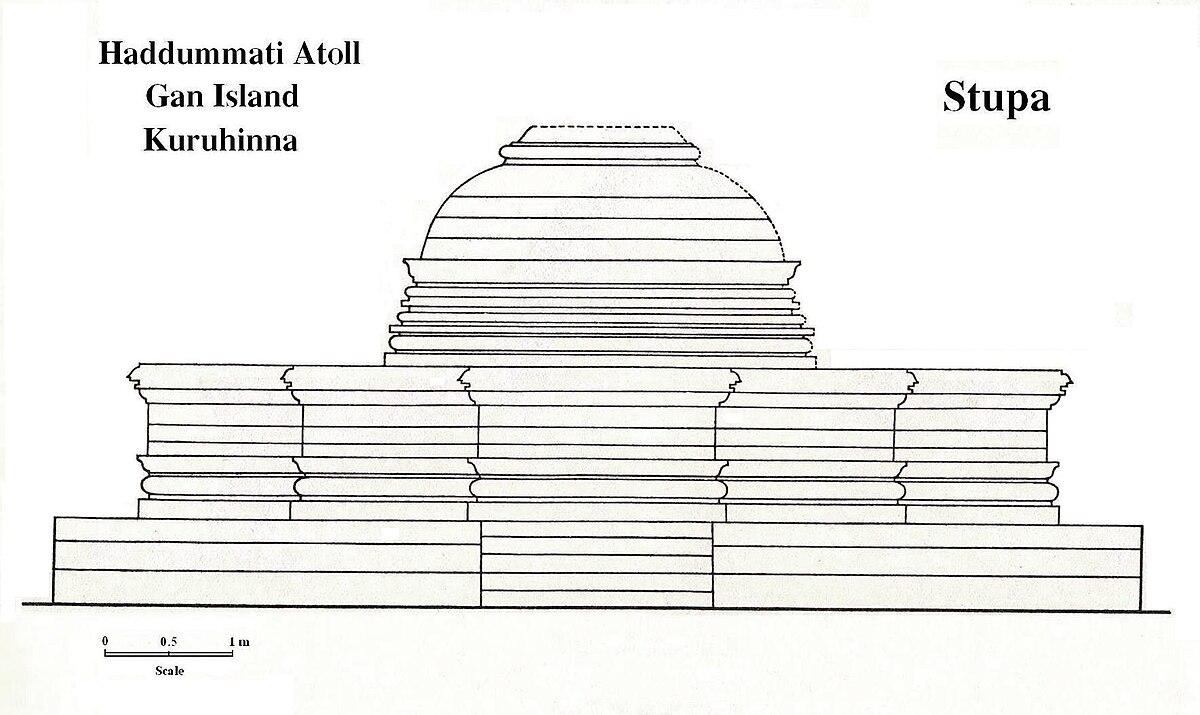
The physical record of this world is extraordinary. Widespread coral-stone ruins — stupas, sanctuaries, bathing tanks — are documented on dozens of islands, and modern excavations continue to unearth seated Buddhas, bronze statues and carved Sanskrit inscriptions. The language, Dhivehi, evolved its own writing system — Eveyla Akuru — directly influenced by the scripts that accompanied Ashoka's Buddhist missions.
The conversion to Islam in 1153 was deliberate and, in places, violent. But the physical traces of a thousand Buddhist years are still there if you know where to look: on the reef edges of Haddhunmathi, in the coral foundations of old mosques, in the Sanskrit loanwords that fill the Dhivehi language every time someone counts to ten.
Continue the timeline.
- H. C. P. Bell, The Maldive Islands: Monograph on the History, Archaeology and Epigraphy (Ceylon Government Press, 1940)
- Xavier Romero-Frias, The Maldive Islanders (Nova Ethnographia Indica, 1999)
- Wikipedia — Buddhism in the Maldives
Two thousand years of history — one extraordinary place to experience it.
The atolls in this story are the islands you can stay on today: private-island resorts and overwater villas, planned by a team that works from inside the Maldives.