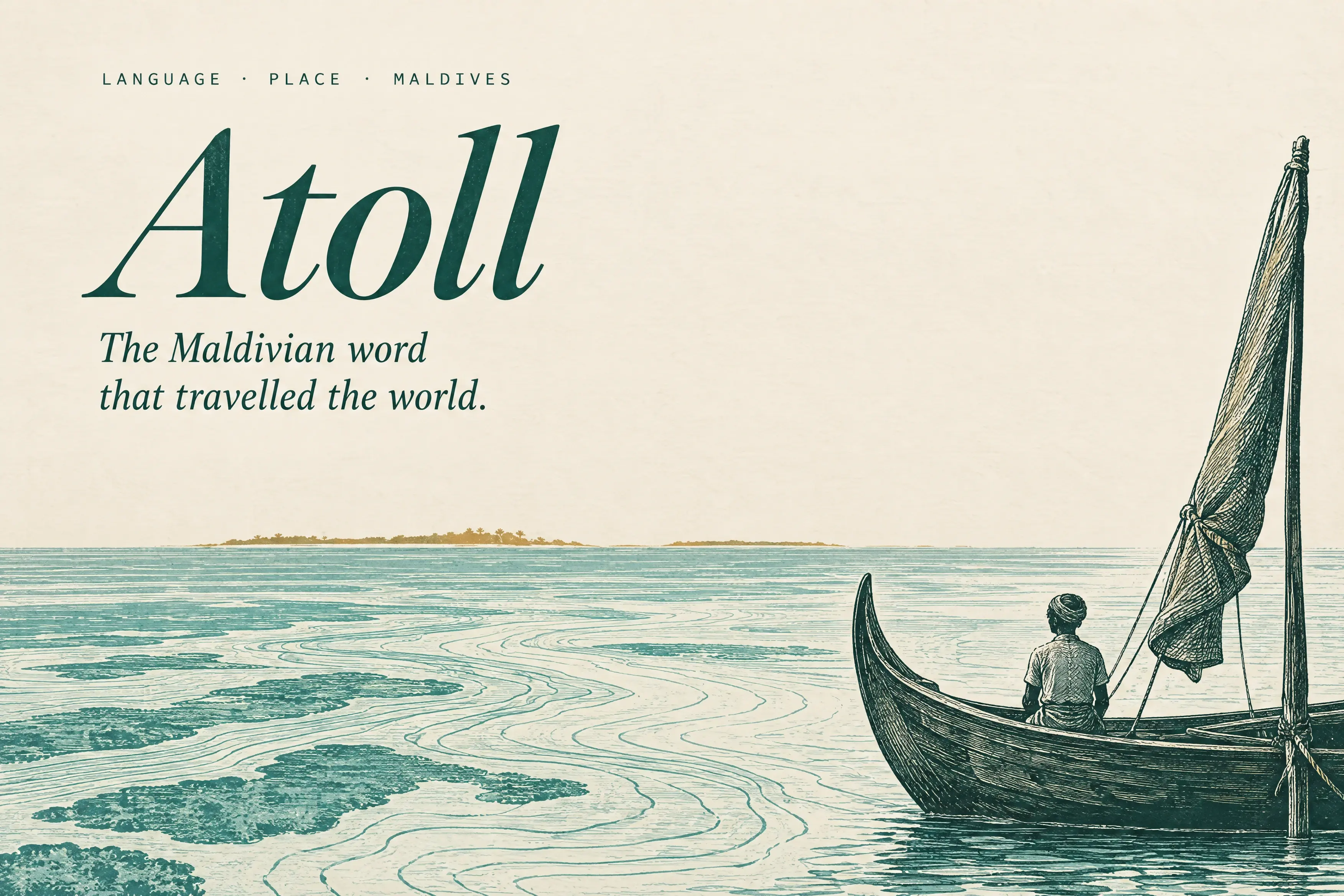
Say “atoll” and you are using a word English borrowed from the Maldives.
It appears on maps of the Indian Ocean and the Pacific, in scientific papers and in the addresses of resorts. Familiarity has made its origin easy to overlook. The word belongs to the history of Dhivehi, the language of the Maldives, before it belongs to the vocabulary of international travel.
Merriam-Webster traces the English word to Dhivehi atolu and dates its first known English use to 1625. The modern Roman spelling atholhu is also widely used; in Thaana, it is written އަތޮޅު. Merriam-Webster, Thaa Atoll Office
More than four centuries after that recorded English appearance, the word offers a good place to begin a different kind of journey through the Maldives. Begin with the name, then look more closely at the water.
A word carried into print
Early European accounts encountered an island world that already had its own names and ways of describing space.
One of those accounts belonged to François Pyrard de Laval, a French traveller who spent five years in the Maldives after being shipwrecked there in 1602. An abbreviated English translation of his observations appeared in Samuel Purchas’s Pilgrimes in 1625—the same year Merriam-Webster gives for the earliest known English use of atoll. Pyrard’s account in Purchas
The older form atollon preserves something of the word’s passage through European writing. In an English translation of Pyrard published in 1887, his description makes the distinction between a group and its individual islands particularly clear:
> “For each atollon is separated from the rest, and contains in itself a great number of little isles.”
That English wording comes from the later translation. What it conveys is older: a visitor trying to explain a geography through the terminology he encountered there. Pyrard, chapter X, 1887 translation
A date in an English dictionary marks a surviving written record. The life of the Dhivehi word in the islands reaches beyond that record.
Darwin’s choice of words
In 1842, Charles Darwin published The Structure and Distribution of Coral Reefs. Near the beginning, he paused to explain his terminology.
Using “island” for an entire formation, he wrote, could create confusion. He chose atoll, acknowledging it as:
> “the name given to these circular groups of coral islets by their inhabitants in the Indian Ocean”
The acknowledgement matters. Here was a word already used to describe an inhabited geography, becoming a term through which scientists could compare reef formations across oceans. Darwin, 1842, introduction, page 2
Darwin’s book gives the word a striking visual setting. His plates distinguish atolls, barrier reefs and fringing reefs, and include both the Maldivian archipelago and formations far beyond it. A term with a Maldivian origin was helping organise a much wider view of the sea.
There is something worth holding on to in that exchange. A local name could carry enough precision to become useful elsewhere. Its journey into science began with people already naming the place in which they lived.
The geography inside the name
An atoll is usually circular or oval, with a lagoon at its centre. Parts of its reef platform may support islands, while gaps provide openings into the lagoon. The familiar ring is a useful starting image, although the reef need not appear as an unbroken circle of land. NOAA’s explanation of reef forms
That distinction changes the scale of what you are looking at.
A beach belongs to an island. The island may sit within a much larger arrangement of reef, lagoon and passages. The water is part of the geography being named.
For a traveller, the word offers a small adjustment of attention. Look beyond the outline of the island where you are staying. Notice the reef edge, the expanse inside it and the openings through which a boat approaches. The destination becomes easier to imagine as a connected marine landscape.
It also becomes easier to understand why a term for the whole formation was useful long before it appeared in a travel brochure.
Learning to read a more detailed sea
Atholhu is one word in a much larger vocabulary.
Hassan Ahmed Maniku’s A Concise Etymological Vocabulary of Dhivehi Language, published in 2000 and hosted online by the University of Chicago, records distinctions that reward a slower look at the map.
- Thila — ތިލަ: a shoal or shallow shelf. Maniku, page 237
- Giri — ގިރި: a coral formation within an atoll or lagoon. Maniku, page 101
- Fushi — ފުށި: a minor island; the dictionary also records senses connected with stony or unproductive land. Maniku, page 93
A dictionary supplies a starting point. A local guide, boat crew member or knowledgeable island resident can explain how a name relates to the place in front of you. That conversation gives the word a setting, an application and a speaker.
Even a familiar island name can become more interesting when somebody explains how it is said locally, what part of the name they recognise and which questions its history leaves open.
Why the map has more than one layer
Travel through the Maldives also introduces another kind of naming: administrative atolls and their code names.
A familiar label such as Baa sits alongside the geographical name Maalhosmadulu Dhekunuburi. The UK’s geographical-names factfile records both, and explains that administrative atolls are identified through geographical names and Maldivian-script code letters. Maldives Toponymic Factfile
A natural reef formation and an administrative division answer different questions. One describes physical geography; the other helps organise places and their administration. Their boundaries and names cannot simply be treated as interchangeable.
For travellers, recognising those layers makes addresses and maps less bewildering. The short name on a resort itinerary may be one of several ways a place is identified. Longer names, local spellings and administrative labels can all belong to the same journey.
The layers are worth noticing. They make a map something to read, rather than merely a surface on which to locate a hotel.
Dhivehi in the present tense
The word atoll has travelled into other languages. Dhivehi continues its own life in the Maldives.
Maniku opens his dictionary by bringing together three names: Dhivehin, the people; Dhivehi Bas, the language; and Dhivehi Raajje, the country. He places them within the island world in which people live and speak. That wider relationship deserves attention alongside the journey of a single loanword. Maniku’s introduction
Modern Dhivehi is written in Thaana, a right-to-left script with vowel signs. Its appearance on a sign or a page is a reminder that the Roman spellings visitors encounter are one way of representing a language with its own writing system. The Unicode Standard’s account of Thaana
The language also varies across the archipelago. Maniku’s dictionary records regional forms within individual entries: fushi, for example, has forms recorded for Huvadhoo, while thila has a form recorded for Fuvahmulah. The islands hold differences in speech as well as differences in landscape. Maniku, fushi, thila
There are contemporary spaces in which that language is being discussed, written and celebrated. In September 2026, the Maldives National University reported Dhivehi Day activities at its Thinadhoo Campus, including writing and presentation competitions. It is one campus’s account, but a useful glimpse of the language in the present tense. Maldives National University
Visitors encounter a living language, with current users and concerns, as well as a history.
The knowledge a word can hold
That connection between language and place has practical consequences.
In a 2025 exploratory study, Naashia Mohamed, Mizna Mohamed and Mohamed Inaz examined language and environmental knowledge through qualitative work involving 135 participants across seven Maldivian island communities.
Within those communities, they described changes in familiarity with local landscapes and lifeforms, connecting them with shifts in language use, education and everyday contact with nature. Their work treats language and ecological knowledge as closely connected. Read the study
The study gives the story of atoll a contemporary dimension. A word can remain familiar internationally while the more detailed knowledge surrounding its home environment requires attention.
There is room in a journey for that expertise: the names people use, the distinctions they make and the experiences through which they learned them.
The questions are specific. What is this feature called? How is it different from the next one? Who taught you its name?
A different way to arrive
You do not need to arrive with a glossary committed to memory.
Start with one word already in your itinerary. Ask how it is said, how it is written and what it refers to locally. Allow the answer to become a conversation rather than another item collected on the trip.
A good guide can help put names beside the landscape. A boat journey can become an occasion to ask about the places being passed. An island visit can include time to listen to somebody explain the name of their home.
An itinerary can give you an address and a transfer time. Understanding the name adds another kind of detail: a connection with the people who use it, and a reason to listen when they describe their surroundings.
The history of atoll makes that value unusually visible. The word appears far from the Maldives, yet its origin still leads back to Dhivehi and to an island world already understood and named by the people living there.
The next time you say atoll, the Maldives is already in the sentence.
Written by
Resortlife Editorial
The editorial team at Resortlife Travel — a Maldives DMC since 2006, writing from Malé, Dubai, and the UK. Our guides are built on first-hand reporting, contracted-rate knowledge, and two decades of agent relationships.