
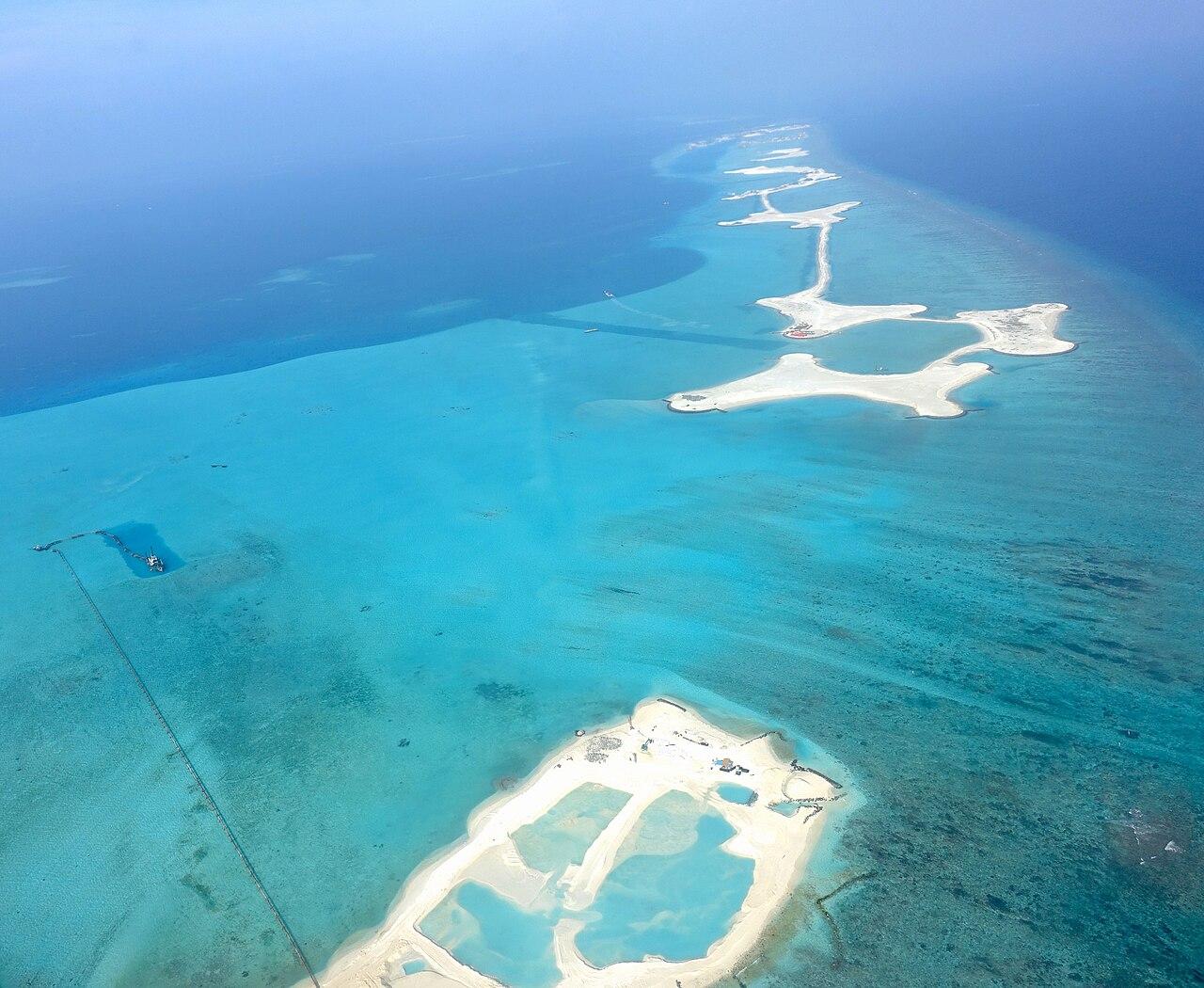
The Island That Was Built.
Two metres above sea level — double the national average — Hulhumalé is an entirely artificial island, reclaimed from a reef flat by dredging coral sand. By 2030 it will house a third of the country's population. It is the Maldives' most visible answer to the rising sea.
Hulhumalé — literally 'New Malé' — is the largest inhabited island in the country, and none of it existed before 1997. The project began under President Gayoom as a response to Malé's chronic overcrowding (the capital island is less than six square kilometres and housed over 100,000 people). It accelerated after the 2004 tsunami, when climate adaptation became explicitly state policy.
Phase 1 (1997–2002) reclaimed 188 hectares. Phase 2, completed in 2015, added another 240 hectares. Phase 3 is under way. The reclaimed land sits 1.8 to 2 metres above sea level — engineered to be the safest place in the country during storm surge or long-term sea rise.
The ambition is extraordinary. By 2030, the Hulhumalé plan envisions housing 240,000 people — roughly 40 percent of the national population — on a single dredged island. Critics point out that concentrating a third of the country in one place creates new vulnerabilities: infrastructure strain, reef loss from dredging, and an open question about what happens to the 200+ outer inhabited islands that won't be similarly elevated.
The Sinamalé Bridge, opened in 2018 with Chinese funding, physically links Malé, the airport island of Hulhulé, and Hulhumalé into a single metropolitan area. It is the largest infrastructure project in Maldivian history — and the most complete statement, in concrete and steel, that the country intends to remain.
Continue the timeline.
- Wikipedia — Hulhumalé
- Housing Development Corporation (HDC) — Hulhumalé
- Britannica — Maldives: Settlement patterns
Two thousand years of history — one extraordinary place to experience it.
The atolls in this story are the islands you can stay on today: private-island resorts and overwater villas, planned by a team that works from inside the Maldives.