
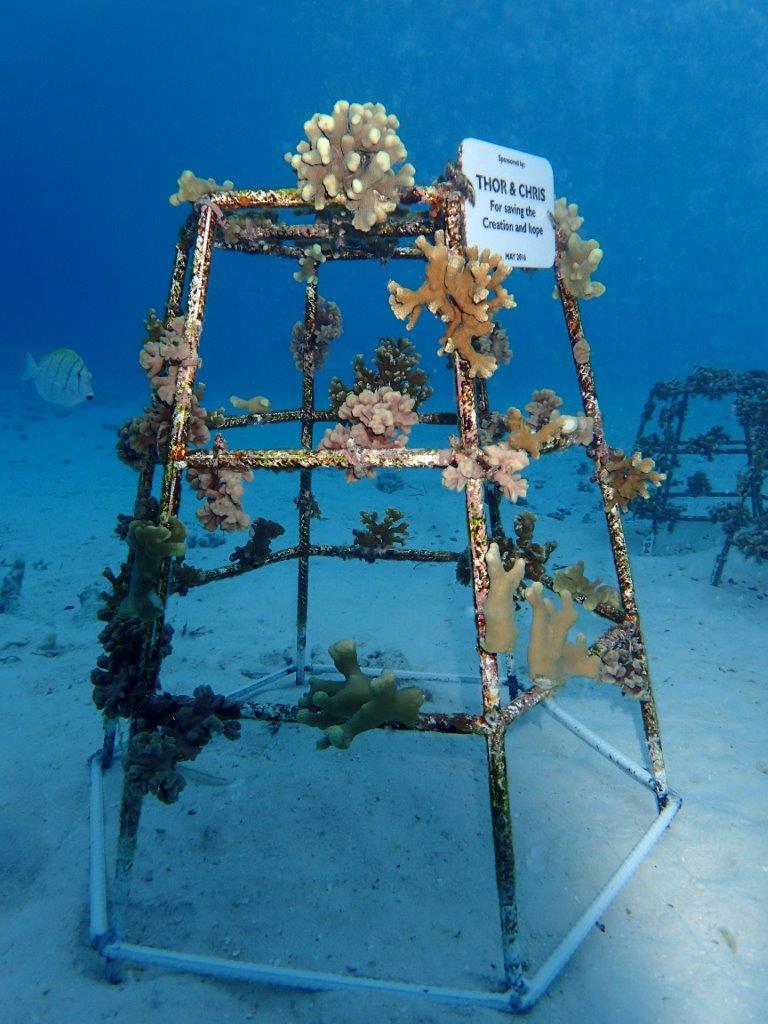
Gardening the Reefs.
Storm-broken coral fragments are lashed to steel frames, lowered into lagoons, and grown out like nursery plants. By 2024, more than 600,000 coral fragments have been replanted across the archipelago. It is slow, patient work — and the only hope the reefs have of outpacing a warming ocean.
The Maldivian reefs are the foundation of everything. Without the reefs, there are no fish stocks — and the country loses its oldest industry. Without the reefs, the wave energy that every storm now carries arrives at island shores undiminished — and houses come down. Without the reefs, there is no diving, no snorkelling, no lagoon colour — and one of the most valuable tourism propositions on earth evaporates.
The reefs are also dying. Two severe bleaching events — 1998 and 2016 — each killed roughly 60 percent of coral cover nationwide. The 2016 bleaching, driven by a record El Niño, was the largest single mortality event ever recorded on Indian Ocean reefs.
Coral gardening is the response. Starting with small, researcher-led trials in the 2000s, by the mid-2010s resort-funded nurseries had scaled across the country. Fragments of fast-growing Acropora and Pocillopora corals are cable-tied to steel frames in shallow lagoons, grown for six to twelve months, then out-planted onto degraded reef. Dozens of resorts — Four Seasons Landaa Giraavaru, Six Senses Laamu, Anantara Kihavah, and others — run continuous programmes.
The science is genuinely contested. Critics note that gardening is a band-aid: it cannot keep pace with the rate at which warming is killing reefs globally. Supporters argue that it buys time for specific sites, protects specific islands, and — crucially — produces the public-facing moments that make climate abstraction concrete for the travelling public. Both are right.
As of 2024, more than 600,000 coral fragments have been planted in Maldivian waters. The country has become, without quite intending to, one of the world's largest open-air coral laboratories.
We are trying to grow a reef faster than the ocean can kill one.
Continue the timeline.
- Reefscapers — Coral Frame Programme, Maldives
- IUCN — Reef rehabilitation and coral restoration
- Wikipedia — Coral reef restoration
Two thousand years of history — one extraordinary place to experience it.
The atolls in this story are the islands you can stay on today: private-island resorts and overwater villas, planned by a team that works from inside the Maldives.