
One-and-a-Half Metres.
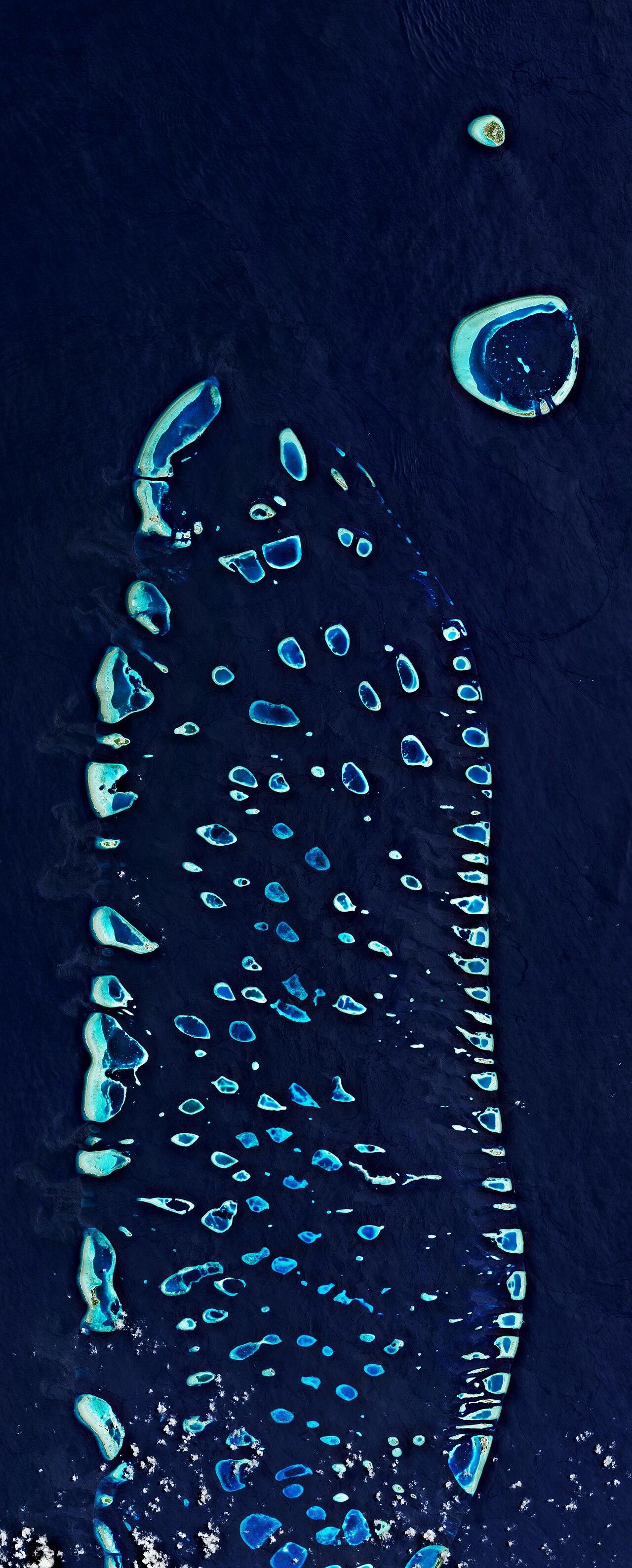
The Maldives' average elevation above sea level is one and a half metres. IPCC high-emissions projections for 2100 put sea-level rise at up to one metre. The country now plans on two time horizons: protect what is here, and prepare, quietly, for everything else.
The math is unforgiving. The highest natural point in the entire country is 2.4 metres above sea level — on Villingili in Addu Atoll. The average is 1.5 metres. Under the IPCC's high-emissions scenario (SSP5-8.5), global mean sea level rises by 0.6 to 1.1 metres by 2100, and by 2 to 5 metres by 2150. In the worst plausible case, much of the Maldives would simply cease to be land.
Adaptation has been under way for two decades. Sea walls now protect Malé, Hulhumalé, and the airport. Dredged islands continue to rise. The government has committed to 100 percent renewable electricity by 2030 (the current figure is around 12 percent; the target is ambitious). Coral nurseries buy ecosystem time. Early-warning systems, toughened after 2004, are now operational in every atoll.
But the conversation that the Maldivian foreign ministry has been having, quietly, since about 2008, is the one that goes beyond adaptation. What happens if the sea wins? Where does a nation go? What does statehood mean in exile? President Nasheed spoke publicly in 2008 about a sovereign wealth fund to purchase land abroad for eventual resettlement. The idea has not been formally pursued — but it has not been formally retracted either.
There is a third path, the one most Maldivians actually believe in. It is that the country exists, has always existed, on the thinnest edge of the sea — and that the people who have survived here for three and a half thousand years will survive the next century too, using some combination of adaptation, political pressure, and the sheer creativity that has kept the country free since Thakurufaanu.
The story is not finished. That is the point.
We do not want to leave the Maldives. We do not want to leave our country. But we will, if the rest of the world will not help us.
Continue the timeline.
- IPCC AR6 WG1, Chapter 9: Ocean, Cryosphere and Sea Level Change (2021)
- Ministry of Environment, Climate Change and Technology — Maldives NDC Update (2020)
- Nasheed, Mohamed. Various addresses to the UN General Assembly (2008–2013)
Two thousand years of history — one extraordinary place to experience it.
The atolls in this story are the islands you can stay on today: private-island resorts and overwater villas, planned by a team that works from inside the Maldives.