
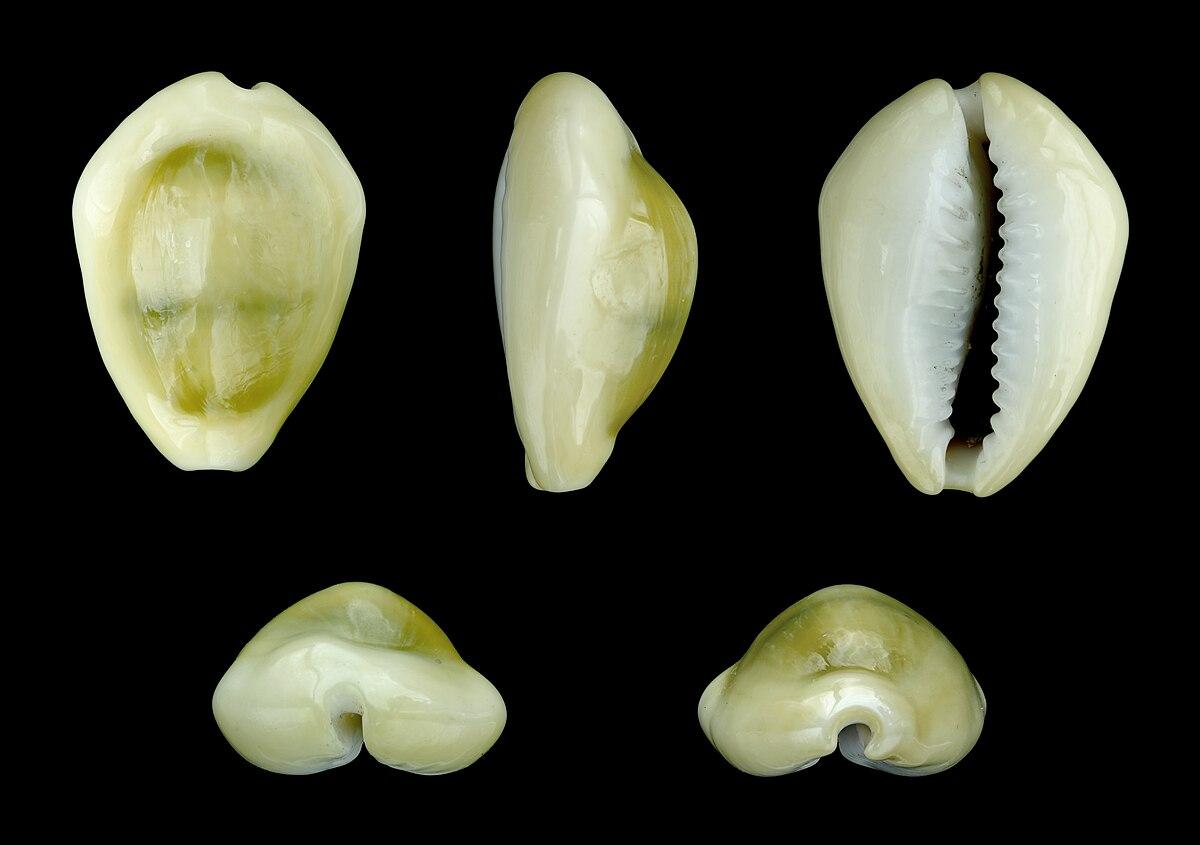
Cowrie Shells: The World's First Global Currency.
How a thumbnail-sized sea snail, raked from Maldivian lagoons, became the first money to travel the world.
Long before the islands have a name, they are the world's money factory. Fishermen rake Cypraea moneta from shallow lagoons with palm-frond traps. The shells travel in coconut-matting bundles to Bengal, the Swahili coast, and across the Sahara — the epicentre of history's first truly global currency.
Born in the lagoon.
The money cowrie, Monetaria moneta, bred in the warm, predator-free lagoons of Haddhunmathi, Huvadhu and Ari atolls in quantities matched nowhere else on earth. Small, glossy and almost impossible to forge, it was nature's answer to the minted coin — and for over a thousand years the Maldives held a near-monopoly on it.
Long before the islands carried a single name on a European chart, they were the world's money factory: a mint with no metal, no furnace and no seal — only the slow, reliable arithmetic of the reef.
Raked from the shallows.
The method was ancient and patient. Fishermen laid branches of coconut palm in the shallows; the snails crawled onto the fronds; the fronds were hauled ashore and left in the sand until the flesh decayed, leaving pristine white shells behind.
Ibn Battuta, who served as the islands' chief judge in the 1340s, recorded queens keeping royal depots bulging with shells — the medieval equivalent of a central-bank vault, counted out in handfuls rather than ingots.
Across half the world.
Arab, Persian and Yemeni ships carried Maldivian cowries as ballast across the Arabian Sea, trading them for the Bengali rice that fed the islands. By the 16th and 18th centuries, Portuguese and other European traders had co-opted the network, pumping Maldivian shells into West Africa, where they became a reference currency of the transatlantic slave trade.
The scholar Bin Yang called the Maldives the epicentre of a 'cowrie money world' that stitched the Indian Ocean to the global economy for fifteen centuries — until colonial demonetisation and the abolition of the slave trade finally collapsed the system in the 19th century.
The queens of the islands fill entire palace chambers with these white shells, and no merchant leaves without them.
The long arc.
- 2nd c. BCE
Into the trade winds
Maldivian money cowries enter the Indian Ocean exchange, moving north and west as ship ballast and small change.
- c. 1340s
The royal vaults
Ibn Battuta records Maldivian queens storing shells by the chamber-full — a state treasury denominated in seashells.
- 16th–18th c.
The Atlantic turn
European traders route Maldivian cowries to West Africa, where they become a reference currency of the transatlantic slave trade.
- 19th c.
Demonetised
Colonial currency reforms and the abolition of the slave trade collapse the cowrie economy after fifteen centuries.
Continue the timeline.
- Yang, Bin. Cowrie Shells and Cowrie Money: A Global History (Routledge, 2018)
- Al Mas'udi, Murūj al-Dhahab (943 CE)
- Alberuni, Kitāb al-Hind (1020 CE)
The islands that once minted the world's money now hold its most coveted stays.
The same atolls, the same lagoons — now home to private-island resorts and overwater villas. Our team plans every trip from inside the Maldives.